Ch5-2 · 军备控制:SALT I 1972、ABM 条约与从未获批的 SALT II
Superpower Relations and the Cold War, 1944–90 — Unit 5: Détente and its Endings 1963–79
第 2 / 5 讲 1969.11 SALT 谈判启动 1972.5 SALT I ABM 限制 2 处 ICBM 1618 : 1054 1974 海参崴框架 1979.6 SALT II 签而不用 教材《A World Divided》Ch7这一课的主线
Why did it take four years (1968–72) to produce the first real arms limitation agreement — and why, when SALT II was finally signed in 1979, did the US Senate refuse to ratify it? What does the fate of SALT tell us about the limits of Détente itself?
- Why · 为什么要"限制"而不是"裁掉"?——因为 MAD 已成事实:只要双方都能毁灭对方,比的就不是"谁更多",而是"别失控、别太贵、别逼对方先动手"。所以 SALT 管的是发射器的数量,不是核弹头的总数
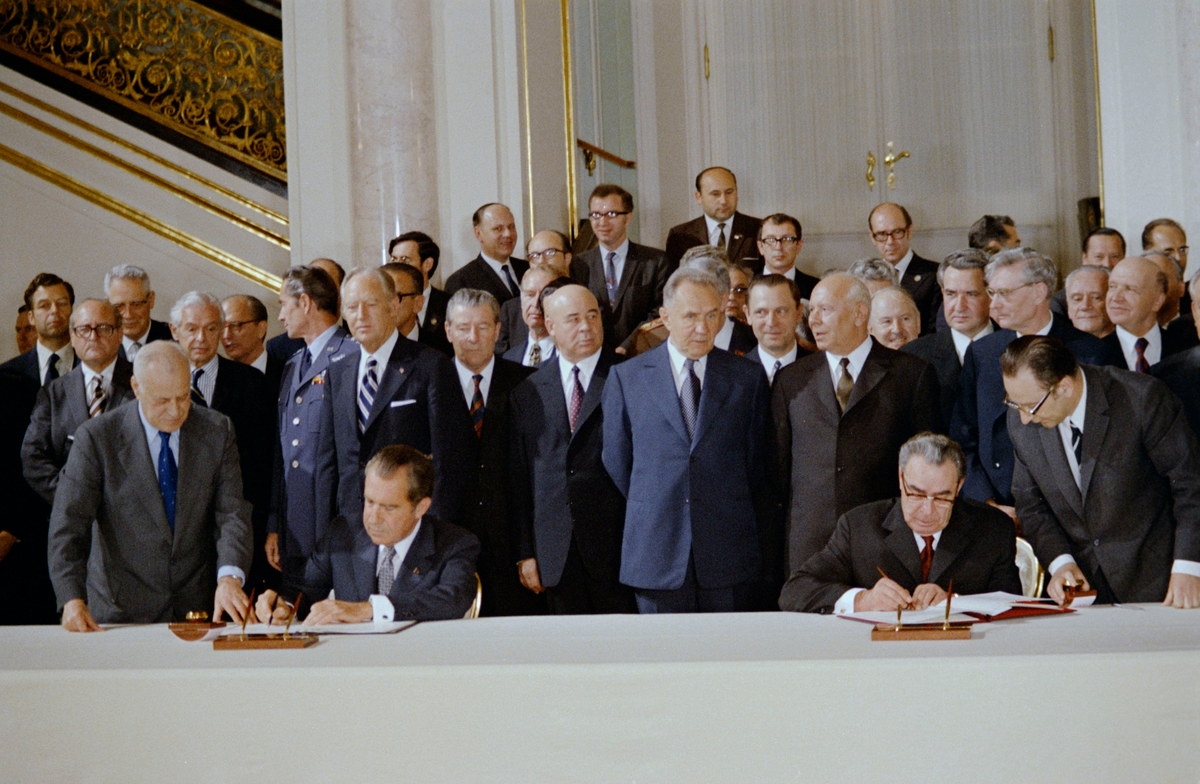
- What · SALT I 到底谈成了什么?——1972.5.26 莫斯科,尼克松与勃列日涅夫签了两份文件:ABM 条约(限反弹道导弹系统)与《限制进攻性战略武器临时协定》(冻结 ICBM/SLBM 数量五年)
- So · 为什么它既被称为"缓和的高峰"又被骂成"软弱"?——因为它冻住了数量,却没冻住质量:MIRV 分导式多弹头不在限制内,双方的毁灭能力反而继续暴涨
- What next · SALT II 为什么胎死腹中?——从海参崴框架(1974)到维也纳签字(1979.6),每一步都踩在美苏关系恶化的鼓点上;1979.12 苏联入侵阿富汗后,SALT II 被永久搁置
一、知识地图:军备控制这条线怎么走过来的
| 年份 | 条约 / 事件 | 管什么 | 没管什么 |
|---|---|---|---|
| 1957 | Rapacki Plan(波兰提出中欧无核区) | 提议在中欧设无核区 | 美国认为会削弱北约,未采纳 |
| 1963 | 《部分禁止核试验条约》(PTBT) | 禁止大气层/水下/太空核试验 | 地下试验不限;不减一枚核弹头 |
| 1968 | 《不扩散核武器条约》(NPT) | 防止更多国家拥核 | 不约束美苏自己的核武库 |
| 1969.11 | SALT 谈判在赫尔辛基启动 | 限制战略核武器 | — |
| 1972.5 | SALT I:ABM 条约 + 临时协定 | ABM 各限 2 处;ICBM/SLBM 冻结 5 年 | 不限 MIRV、不限战略轰炸机、不限核弹头总数 |
| 1974.11 | 海参崴峰会(福特—勃列日涅夫)框架 | 给 SALT II 定等量上限 | 巡航导弹(美国领先)被排除 |
| 1979.6 | SALT II 在维也纳签署 | 发射器与战略轰炸机总量上限 2,250 | 从未获美国参议院批准 |
| 1980.1 | 美国中止批准程序(抗议入侵阿富汗) | — | 条约事实上死亡 |
二、背景链:为什么 SALT 从 1968 谈到 1972 才签字?
- ① 1968 本该开谈,被布拉格之春打断——1968.7 苏联已准备谈限制战略武器,但 8 月入侵捷克斯洛伐克在美国引发众怒,谈判推迟数月
- ② 两边的武器结构完全不同,没法一比一——苏联靠大推力陆基 ICBM(SS-9、SS-18),美国靠潜射 + 战略轰炸机。所以"谁多谁少"根本不是简单数字问题,谈了三年半才找到一个"篮子"能同时装下两边的家当
- ③ 美国坚持"要限制未来的技术",苏联坚持"只限现有的"——美国知道自己在微电子、制导、计算机上领先,越往后越占便宜;苏联只想把现状冻结,让自己已有的数量优势合法化。这是贯穿 SALT I / II 的根本分歧
- ④ 尼克松 1972.2 访华给了苏联一记"催单"——苏联最怕美中走近,被孤立。中国牌一打,莫斯科立刻有动力签 SALT I:5 月就签了。这是"联系战略"(linkage) 的经典操作
- ⑤ 双方国内都需要一个"成果"——尼克松要转移越战压力、1972 是大选年;勃列日涅夫要向政治局证明和平共处能换来实惠(粮食、技术、声望)
三、主线串讲:SALT I 1972 签了什么(数字必须背)
双方各限 2 处 ABM 部署点(1 处保卫首都、1 处保卫洲际导弹发射场),1974 年修订为各 1 处
苏联 1,618 枚 / 美国 1,054 枚
双方各 740 枚(后续可增至 950,需以 dismantling 老式导弹为代价)
临时协定仅 5 年(至 1977),ABM 条约无限期
"A lot remained unsettled in the SALT treaties. The treaty on offensive weapons was, in particular, thin on substance. Each superpower retained enough nuclear weapons to destroy the other several times over. Nonetheless, they indicated a desire to move away from dangerous confrontation."
—— SALT 条约里悬而未决的东西还很多。关于进攻性武器的条约尤其缺乏实质内容:每一方都仍保有足以毁灭对方好几遍的核武器。尽管如此,它们确实表明了摆脱危险对抗的意愿。
— Steve Phillips, A World Divided
怎么用:这段话是标准的"两面性"论据,答"缓和有多成功"时能直接用。注意它的结构:承认局限 → 转折 → 肯定意义,这正是 L4/L5 答案该有的语气。
四、深挖:SALT II 1979——签了,然后死在参议院
- 1974.11 海参崴(Vladivostok):福特与勃列日涅夫口头达成框架——双方战略武器发射器各限 2,400,其中 MIRV 各限 1,320。但巡航导弹被排除(美国领先),为日后争议埋雷
- 右翼反弹:以参议员亨利·杰克逊(Henry "Scoop" Jackson)为首的参议院右翼认为,所有军控都是"让苏联追上美国优势"的机制。杰克逊—瓦尼克修正案(1974)把贸易最惠国待遇与苏联犹太人移民挂钩,直接毒化了气氛
- 卡特 1977 上台后想"谈得更狠":要求削减(而不只是限制)苏联的重型 ICBM。莫斯科认为这是在推翻海参崴框架,谈判陷入僵局
- 1979.6.18 维也纳峰会:卡特与勃列日涅夫签署 SALT II,总量上限降至 2,250(后调 2,400)。两位领导人当面拥抱——但勃列日涅夫此时已年老体衰,条约本身高度技术化
- 为什么没被批准?三重打击叠加:① 参议院本就怀疑"苏联不可信";② 1979 年第三世界冲突(伊朗革命、尼加拉瓜、安哥拉)让"苏联在扩张"成为共识;③ 1979.12 苏联入侵阿富汗——卡特随即撤回条约、中止批准程序,并对苏联实施粮食禁运、抵制 1980 莫斯科奥运会
五、串线小结:SALT 到底成就了什么?
- 第一次给核军备竞赛装上上限(即便上限很高)
- ABM 条约把"相互脆弱"制度化,降低了先发制人的动机
- 建立常设谈判机制(SCC 常设协商委员会),危机时有得谈
- 带动贸易与人员往来:美苏粮食贸易成为苏联的命脉,也成为美国的杠杆
- 政治象征:1972/1974 尼克松访莫斯科、1973 勃列日涅夫访华盛顿
- 不管质量:MIRV 完全不在限制内,1970s 双方核弹头数量反而翻倍
- 只是冻结,不是裁减:每一方仍能毁灭对方好几遍
- ABM 只限数量,不阻止研发(后来 SDI 就是走这个口子)
- 在国内政治上极其脆弱:杰克逊、里根等批评者认为它是单方面让步
- 最终没能经受住第三世界冲突的冲击
The one-sentence takeaway: SALT did not stop the arms race — it capped its most dangerous and most expensive edges, and in doing so it turned the arms race from a sprint into a managed marathon.
六、课后真题训练
📄 题目原文(教材 Unit 7 SKILLS BUILDER 改编)
How successful were the SALT treaties in limiting the nuclear arms race in the years 1972–79?
You may use the following in your answer and any other relevant examples:
• the ABM Treaty (1972)
• the Interim Agreement on offensive weapons (1972)
• the Vladivostok framework (1974)
• SALT II (1979)
中文意译:1972–79 年间,SALT 条约在限制核军备竞赛上有多成功?
📊 Mark Scheme(Section B 通用档位 + 本题可用论点)
| 档位 | 分数 | 特征 |
|---|---|---|
| L1 | 1–4 | Simple or generalised statements; judgement missing or asserted |
| L2 | 5–8 | Descriptive passages; criteria for judgement left implicit |
| L3 | 9–14 | Attempt to explain links between key features; weak substantiation |
| L4 | 15–20 | Analysis of the relationships between key features; supported judgement |
| L5 | 21–25 | Sustained analysis and discussion; relative significance evaluated |
Indicative content(建议论点)
- 支持"成功":ABM 条约限各 2 处(1974 改为 1 处),消除"防御—先发制人"的不稳定;临时协定首次给 ICBM/SLBM 定量(SSBN/SLBM 740、ICBM 1,618 vs 1,054);建立 SCC 常设协商机制;带动 1972/1974 莫斯科峰会、1973 华盛顿峰会与粮食贸易;把军备竞赛从"数量冲刺"变成"可管理的过程"
- 支持"不成功":只限发射器不限弹头,MIRV 完全不在限制之内 → 1970s 双方核弹头总数反而翻倍;临时协定仅 5 年有效期;SALT II 高度技术化、被批评"参议员看不懂";从未获参议院批准(1980.1 中止),第三世界冲突(伊朗、安哥拉、阿富汗)直接摧毁其政治基础
- 成功标准该怎么定(升档关键):如果"成功"= 消灭核威胁,那 SALT 完全失败;如果"成功"= 为危险的竞争装上护栏、降低误判与成本,那它部分成功。答题时先定义 success 的尺子,是 L4/L5 的标志
💡 中文思路(怎么搭这篇文章)
- 引言先定义"成功":不要直接说"成功/不成功"。给两把尺子:① 是否削减了核武库(显然没有);② 是否管理了军备竞赛(降低成本、减少误判、提供沟通渠道)。本文判断基于后者
- 段落一:ABM 条约——最实质的成就:讲清"为什么限制防御反而更安全"这条反直觉逻辑,这是全场最亮的一段
- 段落二:临时协定——数量上的冻结与它的代价:给出具体数字,并解释"为什么苏联可以多 564 枚 ICBM"(美国战略轰炸机与弹头领先)。这一句让答案有分析而非罗列
- 段落三:MIRV 漏洞——为什么"限了等于没限":1970 年 MIRV 服役、1970s 弹头翻倍。这是本题最重要的反方论据
- 段落四:SALT II 的死亡——政治基础有多脆:海参崴框架 → 巡航导弹争议 → 杰克逊参议员 → 1979.6 签署 → 1979.12 阿富汗 → 1980.1 中止批准。务必区分 sign 与 ratify
- 结论:SALT 在"管理"层面部分成功,在"削减"层面彻底失败;它的脆弱性说明——军控无法脱离整体政治关系而独立存活
✍️ 英文 EXEMPLAR(示范答案)
Any judgement on the SALT treaties depends on what one expects arms control to do. If success means disarmament — a smaller nuclear arsenal and a reduced capacity for destruction — then SALT failed completely, because neither SALT I nor SALT II removed a single warhead. If, however, success is measured by whether the superpowers succeeded in managing a competition that both feared and could not afford, then the verdict is more favourable, though still heavily qualified. On that second measure, SALT achieved something real between 1972 and 1979, and then lost the political ground on which it stood.
The strongest achievement was the Anti-Ballistic Missile Treaty of May 1972, and its significance is easily misunderstood. It is instinctive to think of missile defences as a good thing, but strategically they were profoundly destabilising: if one side could intercept a retaliatory strike, it would acquire a powerful incentive to strike first. By limiting each side to two ABM sites — reduced to one in 1974 — the treaty deliberately preserved mutual vulnerability, and thereby preserved deterrence. This was arms control based on a paradox: safety through the certainty of destruction. Alongside it, the Interim Agreement froze the number of intercontinental and submarine-launched ballistic missiles for five years, at 1,618 and 740 for the USSR and 1,054 and 740 for the United States. The Soviet Union was permitted more ICBMs because the United States held a large lead in strategic bombers and, more importantly, in warheads. Recognising this asymmetry is essential: SALT I was not generosity, but an attempt to balance two structurally different arsenals.
Yet the same agreement contained the flaw that would undermine it. Limits were placed on launchers, not on warheads, and multiple independently targetable re-entry vehicles — MIRVs — were left entirely unrestricted. Since a single missile could now carry several warheads, the totals that mattered continued to climb throughout the 1970s even as the numbers that had been frozen stayed still. Historians have called the Interim Agreement 'thin on substance', and the criticism is fair: each side retained the capacity to destroy the other several times over. What SALT limited was the most dangerous and most expensive edges of the race, not the race itself.
The fate of SALT II shows how dependent arms control was on the wider political climate. Its outline was agreed at Vladivostok in November 1974, but the exclusion of cruise missiles — an area of clear American advantage — guaranteed controversy. Senator Henry Jackson and his allies treated all arms control as a mechanism allowing the Soviet Union to catch up, and Carter's attempt in 1977 to reopen the terms and cut Soviet heavy missiles simply prolonged the negotiations. The treaty was eventually signed in Vienna in June 1979, but it was never ratified. Conflict in the Third World, in Iran, Angola and above all Afghanistan, destroyed the assumption of trust on which ratification depended, and in January 1980 the Senate's approval process was withdrawn. It is worth stressing that SALT II was signed and then abandoned, not rejected before signature: the chronology matters, because it shows that the diplomatic achievement was real and it was politics, not negotiation, that killed it.
In conclusion, the SALT treaties were a partial and reversible success. They did not end the arms race and, measured in warheads, barely slowed it; but they did establish that the race could be regulated, that both sides could accept limits verified by satellite rather than by inspectors, and that mutual vulnerability was preferable to the illusion of defence. Their collapse after 1979 confirms the central lesson of Détente: arms control cannot survive independently of the political relationship it is supposed to stabilise.
示范要点批注:① 引言用两把"尺子"定义 success,直接建立分析框架;② 解释 ABM 的反直觉逻辑(限防御 = 增稳定),是本文最亮的分析点;③ 用"为什么苏联 ICBM 更多"展示结构不对称的理解;④ 强调 sign vs ratify 的时序,体现精确性;⑤ 结论把 SALT 的命运上升到缓和的普遍教训。
✅ 自检清单(交卷前逐条打勾)
- □ 引言是否先定义"success"的衡量标准
- □ 是否讲清 ABM 条约的反直觉逻辑(限制防御反而增强稳定)
- □ 是否给出具体数字(2 处 / 1,618 / 1,054 / 740;SALT II 2,250)
- □ 是否解释"为什么苏联 ICBM 更多"这个不对称
- □ 是否用 MIRV 漏洞作为核心反方论据
- □ 是否区分 sign 与 ratify,且时间顺序正确(1979.6 签 → 1979.12 阿富汗 → 1980.1 中止)
- □ 是否提到国内政治(杰克逊参议员、参议院)这一层
- □ 结论是否给出有层次的判断(partial and reversible success)
七、拓展阅读与思考
- 对照概念:把 SALT(限制)与后来的 START(削减,1991)做对比——为什么 1970s 只能"限"不能"减"?
- 延伸阅读:1972 年《反弹道导弹条约》原文只有 16 条,读一遍能直观感受"军控条约有多薄"
- 思考题:如果 SALT II 在 1979 年获得批准,苏联入侵阿富汗会不会被"约束"住?还是说军控从来就不可能影响苏联在第三世界的行动?这个问题直接通向 Ch5-4 与 Ch6-1
- 史学争议:Garthoff 认为 SALT 建立了宝贵的"军控学习过程";批评者(如 Norman Podhoretz)认为它只是给苏联的追赶争取时间。你站哪边?