Ch2-4 · 柏林封锁 1948–49:空运、西柏林与两德分裂
Superpower Relations and the Cold War, 1944–90 — Unit 2: Development of the Cold War 1945–49
第 4 / 5 讲 1948.6 – 1949.5 教材 Steve Phillips《A World Divided》Ch2一、先搞懂这几个词
柏林封锁 Berlin Blockade
柏林空运 Berlin Airlift
双占区 / 三占区 Bizonia / Trizonia
西德马克 / 货币改革 Westmark
西柏林 West Berlin
两德分立 Two German States
二、背景链:为什么会闹到封锁?
读这条链要抓因果:苏联的"封锁"在它自己叙事里是对西方"单方面"行动的回应;在西方叙事里则是扩张与胁迫。两种叙事都真实存在,考试时都要会写。
三、地图:柏林在苏占区内的四国分区
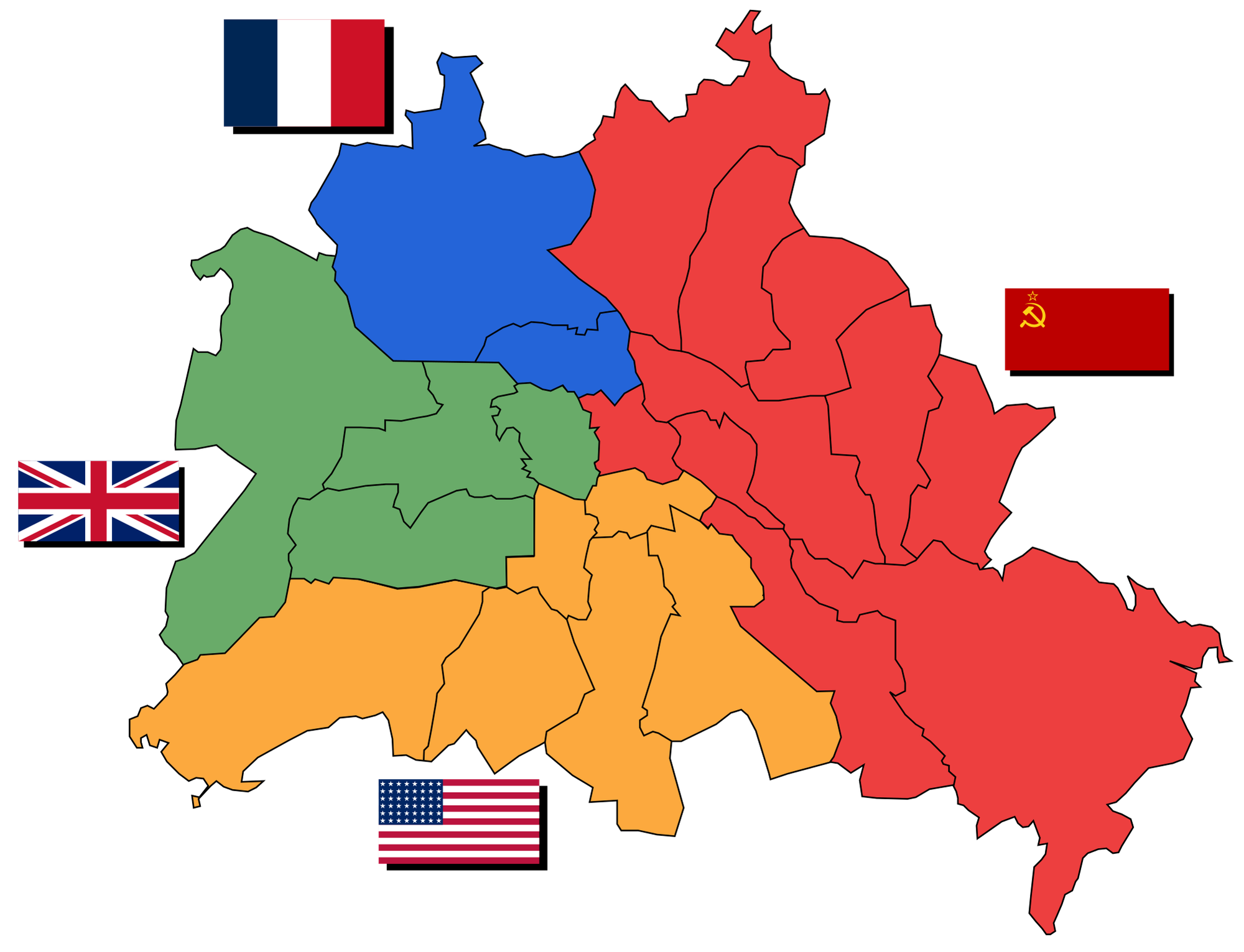
柏林位置示意:西柏林(美英法占区)深陷苏占区内部,仅靠三条空中走廊与西方相连。图源 Wikimedia Commons(CC BY-SA)。
读图要点
- 地理困境:柏林距西方占领区约 100 英里,全被苏占区包围——这是西柏林能被"饿垮"的根本原因。
- 三条空中走廊:西方保留了汉堡-柏林、汉诺威-柏林、法兰克福-柏林三条窄窄的飞行通道(见下一张图)。
- 市内四分区:柏林市内美、英、法、苏各占一块;西柏林三块连成西方飞地。
四、封锁与空运:11 个月的较量
斯大林的算盘
苏联的"挤压策略"(squeeze play):要么逼西方放弃西德单独建国,要么放弃西柏林。切断补给后,西方要么撤出(丢脸),要么武力打通(冒险开战),怎么看都该让步。
但斯大林算漏了两点:西方选择空运(非军事、难指责),以及西柏林人的顽强意志。
西方的回应:空运
杜鲁门决心"留在柏林"。1948.6 起,美英启动空运;法国随后加入。飞机昼夜不停地往西柏林"空投"生存物资。
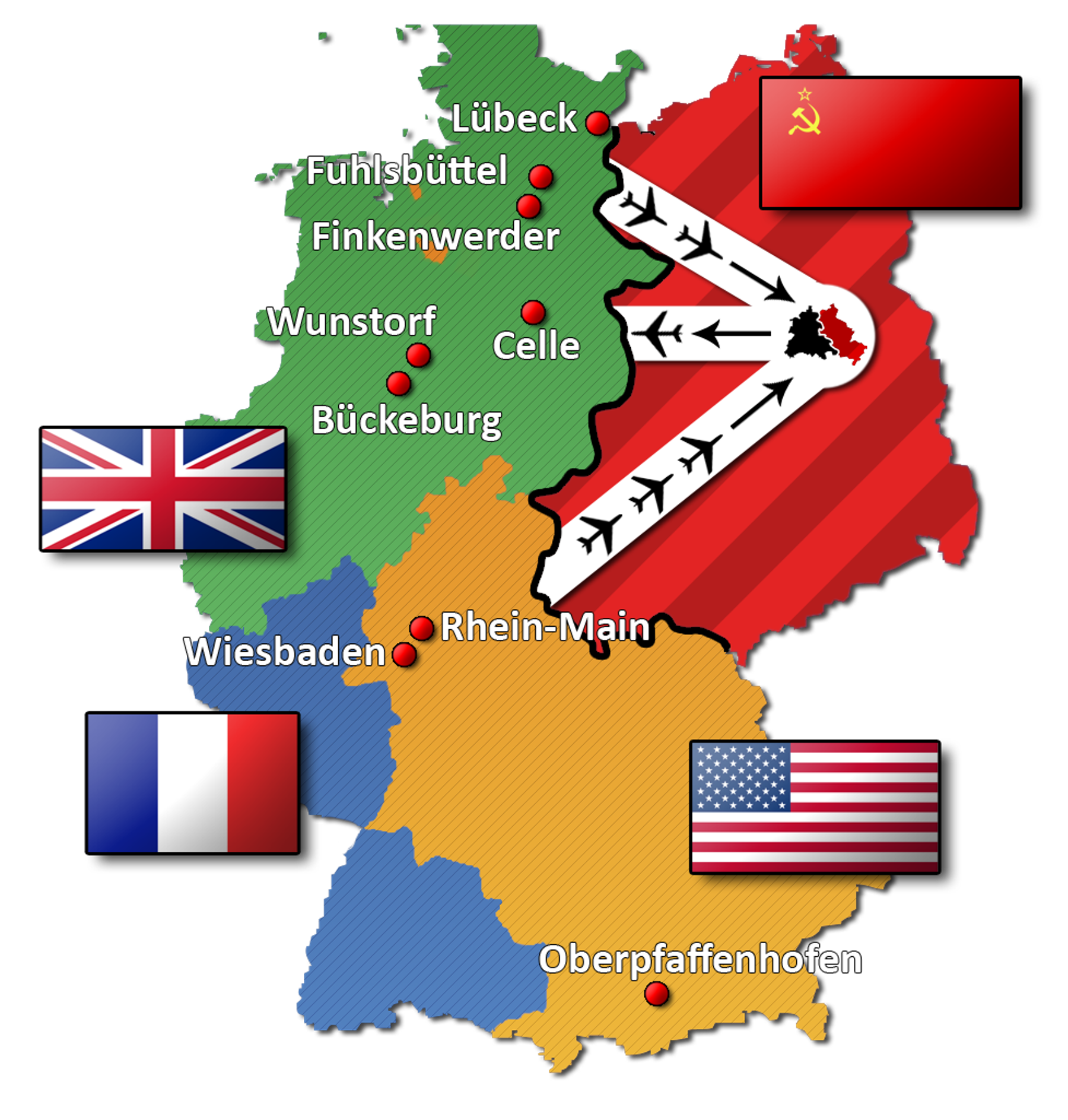
柏林空运三条许可走廊(汉堡 / 比克堡-汉诺威 / 法兰克福 → 柏林)。图源 Wikimedia Commons(CC BY-SA)。
🍬 "糖果轰炸机" Candy Bomber
美军飞行员加伊·哈尔沃森(Gail Halvorsen)在降落时向孩子空投小捆糖果, nicknamed "raisin bombers"。这一温情细节让空运从"补给行动"变成西方道义胜利的象征,也成了考题常考的"软实力"案例。
五、结局与影响
- 1949.5.12 解除封锁:斯大林在几乎一年后仍重开陆路——证明封锁未能逼退西方,反而暴露苏联的局限(不敢击落西方飞机,怕引发战争)。
- 两德分立固化:1949.9 西德(FRG)、10 月东德(GDR)先后成立。德国正式一分为二,并延续 40 年。
- 北约成立:1949.4 北约(NATO)签约,西方军事同盟正式化——封锁"吓"出了西方集体防务。
- 德国成为冷战最前线:柏林此后又爆发 1958–61 危机,直至柏林墙(见 Ch4)。
- 苏联叙事的反噬:如史料 K 所言,封锁"适得其反"(counterproductive)——本想阻止西方一体化,反而加速了西德建国与北约。
六、课堂史料:三则对柏林封锁的不同解读
以下三则均出自教材 Steve Phillips《A World Divided》Ch2 史料(Sources I, J, K)。注意它们立场不同——这是 Edexcel 史料题的核心考点。
Stalin was engaged in what George Kennan called a 'kind of squeeze play'. He wanted to force the Western powers either to give up their moves towards a separate West German state, or to relinquish West Berlin … in a meeting with Yugoslav and Bulgarian communist leaders, Stalin had stressed that Germany would remain divided: 'The West will make West Germany their own, and we shall turn Eastern Germany into our own state'.
— David Holloway, Stalin and the Bomb, in M. Leffler & D. Painter (ed.), Origins of the Cold War (Routledge, 2005)
课堂思考题(英文)
1. According to Source I, what were the two things Stalin wanted to force the Western powers to do?
2. What phrase shows Stalin accepted a permanently divided Germany?
From Russia's perspective the blockade was a legitimate response to the West's unilateral decision to unify the three western occupation zones … including to institute a new currency in the western zones. … Truman was determined to stay in Berlin … Ordinary Germans, Britons and Americans — including the tens of thousands of industrial workers, coal miners, military personnel, and labourers who loaded and unloaded the planes — deserve much of the credit for the airlift's success. Stalin also showed restraint by not ordering Soviet forces to shoot down the planes while they were flying over the Russian zone.
— R. B. Levering & V. Botzenhart-Viehe, The American Perspective, in R. Levering et al. (ed.), The Origins of the Cold War (Rowman & Littlefield, 2001)
课堂思考题(英文)
1. How does Source J portray the Soviet motive for the blockade?
2. Which details in Source J suggest the airlift succeeded due to ordinary people, not just leaders?
… the establishment of a West German state was rightly perceived in Moscow as a complete break with the Yalta-Potsdam agreements … the western powers are transforming Germany into their stronghold … directed against the Soviet Union. Desperate to forestall such developments, the Kremlin decided to counterattack by using the most tangible advantage it still held in Germany: control over the geographic space between the western zones and Berlin. … Stalin's hardball tactics, which he pursued too long, proved to be counterproductive. Instead of blocking the implementation of the Western plan for Germany, the Berlin blockade accelerated it.
— V. Pechatnov & C.E. Edmondson, The Russian Perspective, in R. Levering et al. (ed.), The Origins of the Cold War (Rowman & Littlefield, 2001)
课堂思考题(英文)
1. According to Source K, why did Moscow see West German statehood as a threat?
2. What is the author's final judgement on Stalin's tactics?
📋 SKILLS BUILDER:三则史料综合训练(来自教材原题)
Sources I, J and K give different interpretations on the causes and results of the Berlin blockade.
- 用 不超过 5 个词,概括每则史料对"封锁原因"的解读。
- 你会从每则史料中引用哪句话来支撑其观点?
- 三则史料一致的一点是什么?(提示:都承认柏林封锁是"德分裂"进程的关键节点)
- 三则史料分歧的一点是什么?(提示:对"谁该负责 / 封锁是否正当"判断不同)
七、📖 拓展阅读
为什么斯大林最终让步?——不是心软,是算错了
空运持续近一年,苏联面临尴尬:击落西方飞机等于宣战(它不敢);放任空运则封锁名存实亡。同时西方借机加速西德建国,苏联"以封锁阻止西方一体化"的目标彻底落空。1949.5 斯大林重开陆路,表面是"结束危机",实质是承认策略失败。这印证了 Source K 的"counterproductive"。
空运的"软力量":为何西方赢了人心
对比苏联的"断粮"与西方的"空投糖果",柏林市民(尤其儿童)心理上倒向西边。这种道义形象在冷战宣传战中价值巨大,也是考题常要求分析的"非军事维度的胜利"。
柏林封锁与下一讲(Ch2-5 北约)的直接因果
封锁让西欧(尤其法国)确信:单靠本国无力抵御苏联,必须与美国绑定。1949.4 北约签约,正是封锁"吓"出来的结果。记住这条链:封锁 → 西方恐慌 → 北约成立 → 两极军事同盟定型。
数字里的柏林:230 万吨意味着什么
西柏林 200 多万人,日均需约 4000–5000 吨物资(粮食、煤、医疗)才能存活。空运峰值时每天起降近 1400 架次,间隔仅几分钟——这是人类史上最大规模的和平时期空运。1949.5 解除封锁后,空运仍持续数月以防反复。
⚠️ 考试易错提醒
- 时间点要精确:货币改革 1948.6.18 → 封锁 1948.6.24 → 解除 1949.5.12;别把"封锁开始"和"空运开始"混为一谈(几乎同时,但空运略晚几天)。
- 空运是"政治胜利"而非"军事胜利":西方没开一枪就保住西柏林,靠的是意志与后勤,不是武力。答题时强调非军事对抗(non-military confrontation)。
- 别只写"苏联坏":Level 5 答案必须呈现双方视角(西方货币改革是导火索、苏联有自身安全逻辑),再判断责任归属。Source J/K 就是给你写"平衡论证"的弹药。
八、真题四件套(史料分析 + Essay)
📝 题目(Edexcel 风格 · 史料分析)
How far do you agree with the view that the Berlin Blockade of 1948–49 was primarily the result of Stalin's determination to keep Germany divided and under Soviet control?
要求:结合下列三则史料(Sources I, J, K)与自身知识作答。建议结构:引言表态 → 支持斯大林责任(I、K)→ 削弱:西方行动催化(J + 货币改革)→ 自身知识补后果 → 结论。
📄 Extracts(史料原文)
Source I — D. Holloway: Stalin engaged in a 'kind of squeeze play' to force the West to abandon a separate West German state or West Berlin; he accepted a divided Germany ('we shall turn Eastern Germany into our own state').
Source J — R.B. Levering & V. Botzenhart-Viehe: from the Soviet view the blockade was a legitimate response to the West's unilateral unification of the three western zones and the new currency; credits ordinary workers for the airlift's success and notes Stalin's restraint in not shooting down planes.
Source K — V. Pechatnov & C.E. Edmondson: Moscow saw West German statehood as a breach of Yalta-Potsdam and a threat; the Kremlin used its geographic advantage to counterattack, but Stalin's tactics proved counterproductive — the blockade accelerated the Western plan.
✅ Mark Scheme 要点(indicative content)
- 支持"斯大林主责":Source I 显示其"挤压策略"目标就是阻止西德/保西柏林,并主动接受德分裂;Source K 显示莫斯科视西德为破坏雅尔塔、遂以地理优势"反击"。
- "primarily"受挑战:Source J 表明苏联视封锁为对西方单方行动(统一三占区 + 新货币)的回应——西方挑衅在先,斯大林非唯一动因。
- 自身知识:Bizonia(1946)、伦敦会议(1948.2)决定西德与新货币、1948.6.18 新马克、空运规模、1949.5.12 解除、两德分立(1949.9/10)、北约(1949.4)。
- 结论层级:L4–5 答案须承认"斯大林意图是主因,但西方货币改革是催化剂",并点出讽刺——封锁加速了它本想阻止的西方一体化(呼应 K)。
🧭 中文思路(答题框架)
第一步·表态:同意"斯大林是主因",但要加限定——他的意图是保持德分裂,可封锁是对西方行动的过激反应,西方货币改革是导火索。
第二步·论证 A(支持斯大林责任):用 Source I 的 squeeze play + "Eastern Germany into our own state",说明他主动推动德分裂;用 Source K 的"地理优势反击",说明封锁是其既定方针的升级。
第三步·论证 B(平衡:西方催化):用 Source J 的"legitimate response / unilateral",指出西方 1948.6 单方发行新马克是直接导火索;若西方未推进西德建国,封锁未必发生。这削弱了"primarily Stalin"的绝对性。
第四步·自身知识:补 Bizonia→Trizonia→伦敦会议→新货币→空运→解除→两德分立→北约,展示时序与因果。
第五步·结论:斯大林"保持德分裂"的目标确是主因,但其手段(封锁)适得其反(K 的 counterproductive),反而固化分裂、催生北约——讽刺地加速了西方一体化。
📝 EXEMPLAR(英文范文 · ~1200 词)
How far do you agree with the view that the Berlin Blockade of 1948–49 was primarily the result of Stalin's determination to keep Germany divided and under Soviet control?
The Berlin Blockade of 1948–49 was the most dangerous confrontation of the early Cold War, and historians have long debated who bore responsibility for it. I largely agree with the view that Stalin's determination to keep Germany divided and under Soviet influence was the primary cause, because the documentary evidence shows that dividing Germany served Soviet interests and that the blockade was a deliberate instrument to that end. However, this essay will also argue that the West's own actions — above all the unilateral currency reform of June 1948 — acted as the immediate trigger, and that attributing the crisis primarily to Stalin alone understates the extent to which both sides escalated the confrontation.
There is strong evidence that keeping Germany divided was a long-standing Soviet objective, which supports the interpretation in the question. Source I, drawing on David Holloway, describes Stalin's policy as a "kind of squeeze play" designed to force the Western powers either to abandon plans for a separate West German state or to relinquish West Berlin. Crucially, the source records Stalin telling Yugoslav and Bulgarian leaders that "we shall turn Eastern Germany into our own state," which demonstrates that he had already accepted and actively pursued the permanent division of Germany rather than seeking reunification on Soviet terms. This aligns with the broader context: having failed to keep a unified, friendly Germany at Yalta and Potsdam, Moscow shifted to securing a compliant East Germany as a buffer state. In this sense, the blockade was not an isolated spasm but the logical culmination of a strategy to deny the West a foothold in a divided Germany.
Source K reinforces this reading from the Russian side. Pechatnov and Edmondson note that the Kremlin perceived West German statehood as "a complete break with the Yalta-Potsdam agreements" and concluded that "the western powers are transforming Germany into their stronghold … directed against the Soviet Union." Faced with this perceived threat, the Soviet leadership "decided to counterattack by using the most tangible advantage it still held in Germany: control over the geographic space between the western zones and Berlin." This passage confirms that the blockade was a calculated use of Soviet geographic leverage to halt Western integration — exactly the determination to keep Germany divided that the question identifies as primary.
Nevertheless, to attribute the crisis primarily to Stalin requires qualification, because the Western powers supplied the immediate provocation. Source J, from the American perspective, frames the blockade as a "legitimate response to the West's unilateral decision to unify the three western occupation zones … including to institute a new currency in the western zones." This is historically accurate: in 1946 Britain and America merged their zones into Bizonia, France later joined to form Trizonia, and at the London Conference of February 1948 the Western powers resolved to proceed with a West German government and a new currency. When the Deutsche Mark was introduced in the Western zones and West Berlin on 18 June 1948, Stalin — who had already walked out of the Allied Control Council — responded six days later by sealing all land and water routes. Thus the blockade, while serving Stalin's longer-term goal, was also a reaction to a Western move that Moscow experienced as fait accompli. A balanced answer must acknowledge that without the currency reform, the crisis might not have erupted when it did.
Own knowledge further complicates a simple "Stalin alone" explanation. The roots of the confrontation lay in the wider breakdown of four-power cooperation after 1947: the Truman Doctrine, the Marshall Plan (which Stalin barred Eastern Europe from joining), and the Communist coup in Czechoslovakia (February 1948) all hardened positions. The Western airlift, launched within days of the blockade, demonstrated both resolve and ingenuity: over eleven months some 270,000 sorties delivered around 2.3 million tons of supplies to more than two million West Berliners, turning a potential humanitarian catastrophe into a profound Western propaganda victory. That Stalin "showed restraint by not ordering Soviet forces to shoot down the planes" (Source J) reveals the limits of his coercive strategy — he could neither tolerate the airlift nor risk war to stop it.
The outcome, moreover, undercuts the idea that the blockade achieved its aim. When Stalin lifted the restrictions on 12 May 1949, he had manifestly failed to drive the West out of Berlin. More strikingly, as Source K concludes, "Stalin's hardball tactics … proved to be counterproductive. Instead of blocking the implementation of the Western plan for Germany, the Berlin blockade accelerated it." Within months the Federal Republic (West Germany) and the German Democratic Republic (East Germany) were founded (September and October 1949), and in April 1949 the North Atlantic Treaty was signed — the very Western military integration Moscow most feared. The blockade thus accelerated the division it was meant to prevent and cemented the bipolar order.
In conclusion, I agree that Stalin's determination to keep Germany divided and under Soviet control was the primary underlying cause of the Berlin Blockade: the documentary record shows a deliberate strategy to use Germany's partition and Moscow's geographic advantage to block Western consolidation. However, the word "primarily" should not erase the Western contribution to the crisis; the unilateral currency reform of June 1948 was the catalyst that turned underlying tension into open confrontation. The deepest irony, captured by Source K, is that Stalin's coercion backfired — the blockade did not preserve a Soviet-dominated Germany but instead locked in division on Western terms and hastened the founding of NATO. Any full answer must weigh both the Soviet design and the Western spark.