Alevel 历史 · Ch2-3 马歇尔计划 1948 · 莫洛托夫计划 / Cominform · 经济分裂
Superpower Relations and the Cold War, 1944–90 | Ch2 Development of the Cold War 1945–49(第 3 / 5 讲)
90 分钟:讲解 50′ + 刷题 40′ 教材:Steve Phillips, A World Divided 大纲定位:W2 周三(9/2)本课目标 · Key Questions
- 掌握 马歇尔计划(Marshall Plan / ERP)的提出背景(英国破产、欧洲废墟)、核心内容与三重目的(经济 / 政治 / 战略)。
- 理解苏联的拒绝逻辑——斯大林为何视美援为安全威胁,以及莫洛托夫计划、Cominform、Comecon 的连环反制。
- 分析马歇尔计划如何把欧洲从"政治分歧"推向经济分裂,并为 1949 年两德成立埋下结构性伏笔。
- 运用真题 2025 Jun Q1 训练 AO3 评析技能:权衡"斯大林拒绝马歇尔援助"与"柏林危机"谁才是欧洲分裂的决定性时刻。
- 评价马歇尔计划作为冷战经济战第一枪的意义:从军事遏制(Truman Doctrine)到经济遏制(Marshall Plan)的升级。
教材核心设问:How did the Cold War develop between 1944 and 1953? 本课回答"1947–49 年——欧洲在经济层面被彻底撕成两半"。上一课问'西方怎么反击'(Truman Doctrine),本课问'反击的经济版本是什么、苏联怎么接招'。
一、核心定义 · Key Definitions(点击展开)
Marshall Plan(马歇尔计划 / ERP,1947.6)
Molotov Plan(莫洛托夫计划,1947.7 起)
Cominform(共产党情报局,1947.9)
Comecon(经济互助委员会,1949.1)
Dollar Imperialism(美元帝国主义)
Satellite States(卫星国)
二、从 Truman Doctrine 到 Marshall Plan(背景)
Truman Doctrine(1947.3)解决了"军事/政治遏制"的旗帜问题,但希腊土耳其的危机暴露了一个更深的病灶——欧洲经济正在崩溃,而经济崩溃正是共产主义最好的土壤。
② Marshall 的欧洲之行(1947 春):新任国务卿 George Marshall 遍访西欧,亲眼目睹废墟与经济惨状,意识到光给军援不够,必须救经济。
③ 哈佛演讲(1947.6.5):Marshall 在 Harvard 毕业典礼宣布欧洲复兴计划——"我们的政策不是针对任何国家,而是针对饥饿、贫困、绝望、混乱"。
④ 国会授权(1948.4):经辩论后《Foreign Assistance Act》通过,ERP 正式落地,首批 $5 billion 到位。
⚠️ 注意因果链:Truman Doctrine 是"军事遏制"的旗帜,Marshall Plan 是"经济遏制"的实体。两者共同把 Containment 从口号变成体系。
三、Marshall Plan 详解
3.1 核心内容与附加条件
| 维度 | 内容 |
|---|---|
| 提出 | 1947.6.5 Marshall 哈佛演讲;1948.4 国会授权生效 |
| 受援范围 | 名义上全欧洲(含苏联)均可申请;实际仅西欧 16 国 + 后来西德(1949)接受 |
| 金额 | 1948–52 共约 $13.3 billion(教材记 over $17 billion,含后续相关援助) |
| 附加条件 | ① 公开国家经济账本 ② 向美国资本主义利益开放市场 ③ 接受美国技术顾问——东欧共产党国家无法在不改变体制的前提下接受 |
| 形式 | 70% 赠款 + 30% 贷款;以商品(机器、粮食、燃料)而非现金输送,直接帮美国消化产能 |
3.2 美国的三重目的(教材核心)
① 经济目的(利己)
美国担心:若欧洲经济不恢复,会出现衰退、无法成为美国商品的市场。Marshall 直言"欧洲必须买美国货,美国才能繁荣"。援助本质也是为美国过剩产能找出口。
② 政治目的(反共)
美国人相信"贫困是共产主义最好的温床"。一个繁荣的欧洲更不易被共产主义吸引。救经济 = 防共产党上台 = 巩固西方阵营。
③ 战略目的(Containment 落地)
把西欧绑定在美国主导的体系里,从经济上堵死苏联向西扩张的缝隙——这是 Truman Doctrine 遏制思想的经济版本。Churchill 的评价恰反衬其战略分量:
但"最无私"是修辞:美国同时打开了对欧经济主导权的大门。考试答题要同时看到"人道 + 利己 + 反共"三层,不能只写一面。
📍 现成地图:马歇尔计划受援国
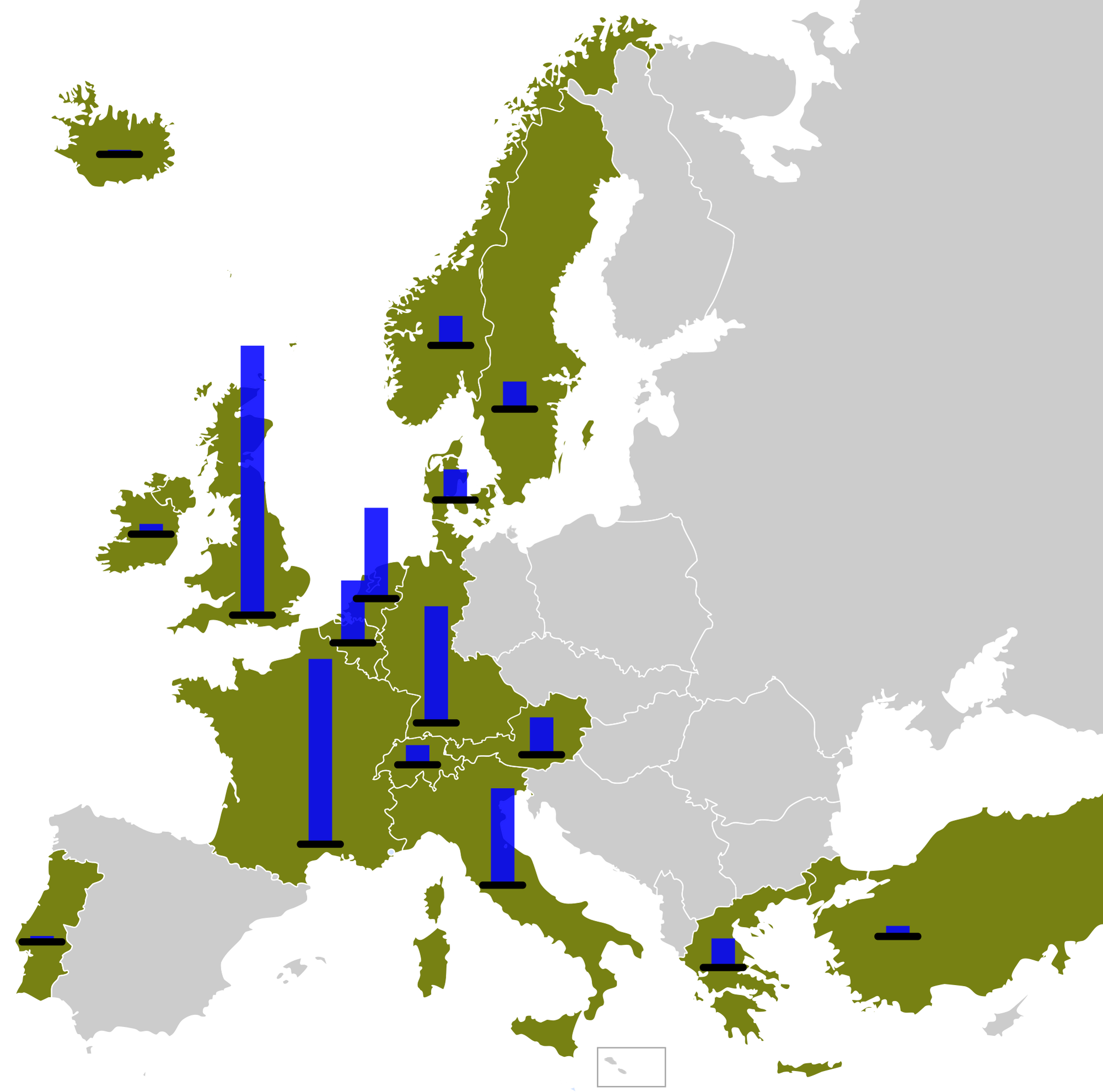
马歇尔计划受援国示意(蓝色立柱表示各国获得援助相对总额)· Map: Miraceti (derivative of Amibreton & Jaman99), CC BY-SA 3.0, via Wikimedia Commons
读图要点:受援国集中在西欧(英、法、西德、意、荷等);东欧卫星国因斯大林强制拒绝而一片空白——这张图本身就是"经济分裂"的视觉证据。
📊 互动图表:各国受援金额(点击柱条查看详情)
单位:百万美元(1948–1952 累计受援)。点击任意蓝色柱条,下方显示框会给出该国受援金额、占总额比重与规模排名。数据约为值,来源:美国国务院马歇尔计划援助统计(总计约 $13.3 billion,本图所列 15 国合计约 $12.1 billion)。
👆 点击上方任意蓝色柱条,查看该国受援金额与占总额比重
四、苏联反应:拒绝 + 连环反制
4.1 斯大林为何拒绝?
斯大林的恐惧是结构性的:苏联经济被战争摧毁、无力自援,只能从德国索取赔偿;若接受马歇尔援助,美国经济影响力将渗入卫星国,动摇苏联的政治控制。Extract 1(Kershaw)精准概括——
因此斯大林的决定是主动而刻意的:拒绝美援 = 保住东欧 = 让西方永远无法渗透。代价是欧洲从此二分。
4.2 强制东欧"跟退"
- 1947.6–7 巴黎会议:英法邀苏联参会讨论马歇尔计划。Molotov 先参加,后奉斯大林命退出——苏联不接受一个"无法控制"的欧洲经济计划。
- 强制跟退:斯大林下令所有东欧卫星国(波兰、捷克斯洛伐克、匈牙利、罗马尼亚、保加利亚)一律拒绝美援。捷克斯洛伐克起初想参加,被斯大林施压撤回——这一幕成为 1948 年共产党政变(本课延伸)的导火索。
- 芬兰、南斯拉夫等亦在不情愿中被卷入拒绝阵营,丘吉尔 1946 年"铁幕"从此从比喻变成现实地理。
4.3 苏联的连环反制
| 组织 / 动作 | 时间 | 作用 |
|---|---|---|
| Molotov Plan(双边经援) | 1947.7 起 | 向东欧提供替代性援助,填补拒绝马歇尔后的真空 |
| Cominform(情报局) | 1947.9 | 政治/宣传:把各国共产党重新拴紧莫斯科,发动全球反美舆论 |
| Comecon(经互会) | 1949.1 | 经济:制度化苏联对东欧的经济控制,阻断西方市场渗透 |
苏联的逻辑很清楚:你用经济手段围堵我,我就用经济手段把你挡在门外。马歇尔计划 → 苏联反制 → 欧洲经济彻底脱钩,这就是"经济分裂"的形成机制。
五、经济分裂:从分歧到结构化割裂
东西欧经济脱钩
1947 年之前,欧洲经济还是一个整体(贸易、供应链互通)。马歇尔计划把西欧绑上美国轨道,苏联反制把东欧锁进计划经济——一道经济铁幕随之落下:货币、贸易、产业链全部二分。
两德成立(1949)
经济分裂最终凝固为政治分裂:西占区 1949.5/9 成立 FRG(西德),苏占区 1949.10 成立 GDR(东德)。这与柏林危机(1948–49)互为因果——见 Ch2-4。Extract 2(Young)强调:正是 1948–49 的一系列事件,让欧洲在"意识形态、政治、经济、军事"各层面刚性分裂。
⚠️ 注意!本课三个易混点
- ① "最无私"≠无利己:Churchill 的评价是修辞,答题务必点出美国的经济/战略动机,否则 AO1 失分。
- ② Cominform ≠ Comecon:前者 1947.9 管政治宣传,后者 1949.1 管经济。两者是苏联反制的两手,别写反时间或功能。
- ③ 拒绝是"主动"还是"被迫"?:斯大林是主动选择拒绝(为保卫星国),不是美国把他踢出去。这是评价"谁导致分裂"的关键——传统派归咎苏联主动关门,修正派认为美国设下东欧无法接受的陷阱。两派都可写,但要分清。
六、课堂史料 · Source Analysis
Source A(西方 / 美国视角)
"The plan committed large sums of American financial assistance to Europe. It was, according to Churchill, 'the most unselfish act in history'. While providing much needed aid for economic recovery and reconstruction, the motives behind Marshall aid were more than merely humanitarian. There were concerns that unless the economies of Europe recovered there would be a danger of economic recession in the USA. Without financial assistance Europe would not be able to act as a market for American goods. In addition to this economic motive there was also a political consideration. The Americans saw poverty as the ideal breeding ground for communism."
设问 1:According to Source A, what were the motives behind the Marshall Plan?
📌 参考回答(英文)
设问 2:How useful is Source A for understanding why the USA launched the Marshall Plan?
📌 参考回答(英文)
Source B(苏联视角)
"The Soviet Union viewed Marshall aid as nothing more than an attack on communism. Molotov condemned it as foreign interference in the states of Europe and labelled the plan dollar imperialism. Under Soviet pressure the countries of Eastern Europe declined the offer of financial aid. The USSR effectively declared war on the Marshall Plan by tightening their hold over Eastern Europe through the setting up of Cominform in 1947 … and Comecon in 1949."
设问 3:According to Source B, how did the Soviet Union respond to the Marshall Plan?
📌 参考回答(英文)
设问 4:Does Source B support the view that Stalin's rejection of Marshall Aid was a decisive step towards division? Explain.
📌 参考回答(英文)
七、📖 拓展阅读(点击展开,内容完整)
📖 拓展阅读:Marshall 哈佛演讲的现场与措辞细节
1947.6.5 的 Harvard 毕业典礼上,Marshall 的发言刻意不点名苏联,只谈"欧洲整体的苦难"。这是精心设计的修辞策略:
- 他把方案包装成"针对饥饿、贫困、绝望、混乱",而非"针对共产主义"——以扩大政治可接受度,避免被指责为挑衅。
- 但关键一句埋下伏笔:"any government that is willing to assist in the task of recovery will find full cooperation on the part of the United States"——表面中立,实则要求开放市场与账本,东欧无法接受。
- 演讲前,Marshall 已让手下(Acheson、Kennan 等)起草方案,核心共识是:救欧洲 = 救美国自己。国务卿本人刚从欧洲考察归来,被废墟震撼,成为推动关键人物。
- 国会起初犹豫(共和党控制、厌战、嫌花钱),直到 1947 夏希腊土耳其危机 + 1948 捷克政变让"共产主义威胁"具象化,拨款才顺利通过。
🎙 演讲原声 · Key Passages(George C. Marshall, Harvard Commencement Address, 1947.6.5)
"The rehabilitation of the economic structure of Europe quite evidently will require a much longer time and greater effort than had been foreseen."
欧洲的经済结构重建,显然需要比预想更长的时间与更大的努力。
"It is logical that the United States should do whatever it is able to do to assist in the return of normal economic health in the world, without which there can be no political stability and no assured peace."
美国理当尽其所能,协助世界恢复正常的经济健康——没有它,便没有政治稳定,也没有可靠的和平。
"Our policy is directed not against any country or doctrine but against hunger, poverty, desperation and chaos."
我们的政策不针对任何国家或主义,而只针对饥饿、贫困、绝望与混乱。
"Any government that is willing to assist in the task of recovery will find full cooperation, I am sure, on the part of the United States Government. Any government which maneuvers to block the recovery of other countries cannot expect help from us."
凡愿协助重建之政府,必得美国政府之全力合作;凡图谋阻挠他国重建之政府,则不可指望美国之援助。
"The initiative, I think, must come from Europe. The role of this country should consist of friendly aid in the drafting of a European program and of subsequent support of such a program so far as we can."
主动权必须来自欧洲;美国的角色,是友好协助欧洲起草方案,并在力所能及的范围内予以支持。
读法:第 1–2 句把援助包装成"普世人道 + 世界和平",刻意回避"反共"字眼;第 3 句是全篇最被引用的名句;第 4 句暗藏条件(愿合作 / 不阻挠他国),东欧若接受即须向美开放市场与账本;第 5 句把"提方案"的责任推给欧洲,既减轻美国被指"主导"的观感,又确保方案符合美方底牌。五句合起来,正是"名义人道、实为遏制"的修辞范本。
📖 拓展阅读:斯大林"主动关门"的深层逻辑
为什么斯大林宁可让东欧饿着也要拒绝美援?三个结构性原因:
- ① 卫星国控制优先:接受美援 = 允许美国经济顾问、审计人员进入东欧 = 西方影响力渗入 = 动摇苏联政治霸权。对斯大林而言,经济短缺的代价 < 失去东欧的代价。
- ② 赔偿依赖:苏联战后重建高度依赖从德国(尤其苏占区)拆走工业设备作赔偿。若东欧向西方开放,苏联的赔偿机制会被打乱。
- ③ 意识形态不信任:斯大林坚信资本主义必然试图摧毁社会主义;马歇尔计划在他眼中不是"善意"而是"渗透武器"。这种认知使妥协空间趋近于零。
- 历史反事实:若斯大林接受(哪怕部分参与),1947 后的欧洲分裂未必如此刚性——但就斯大林的安全逻辑而言,拒绝是理性选择。这恰是考试"谁该为分裂负责"争论的核心:传统派说苏联主动关门,修正派说美国设下东欧无法接受的条件(等于逼退)。
📖 拓展阅读:Cominform 的运作与"开除"Tito
Cominform(1947.9,波兰 Szklarska Poręba 成立)表面是"交流各国共产党经验"的情报局,实质是斯大林控制东欧共产党的指挥棒:
- 机关报《For a Lasting Peace, for a People's Democracy!》在全球发行,基调统一反美,把马歇尔计划骂作"美元帝国主义"。
- 1948 年关键事件:南斯拉夫领导人 Tito 不愿完全听命莫斯科(且和苏联在巴尔干有领土野心冲突),被 Cominform 公开"开除"——这是冷战阵营内部第一次大分裂,也是后来 1948.6 Tito–Stalin 决裂(影响希腊内战补给)的根源。
- Cominform 的"纪律功能"说明:苏联的反制不仅是外部对抗西方,更是内部整肃,确保卫星国不离队。
- 1956 赫鲁晓夫在苏共二十大上承认 Cominform 被用来搞个人崇拜与压迫,随后解散。
📖 拓展阅读:Comecon 的实质与马歇尔计划的"成功数据"
Comecon(1949.1):苏联版"经互会",成员为东欧卫星国 + 后来苏联阵营。与马歇尔计划相比:
- 援助规模小得多,且本质是苏联对东欧的资源抽取(低价原料、强制分工),而非真心重建。
- 作用:阻断东欧与西方市场的联系,固化计划经济,使苏联能持续获取东欧的粮食与原料。
马歇尔计划的"成功"数据(答题可用):
- 1948–52 向西欧输送约 $13.3 billion(按当时币值,相当于今日逾 $150 billion)。
- 西欧工业产量到 1952 年增长约 35%,农业恢复至战前水平。
- 受援国间建立 OEEC(欧洲经济合作组织),为后来的欧共体 / 欧盟埋下制度种子。
- 政治效果:西欧共产党选票在 1948 后普遍下滑,共产主义威胁被实质性遏制——证明"救经济 = 防共"逻辑部分成立。
⚠️ 但"成功"是西方的叙事。对东欧而言,马歇尔计划留下的不是繁荣,而是一道被强制拒绝的经济铁幕。
八、真题演练 · 2025 年 6 月 Q1(四件套)
本题直击本课主题:"斯大林拒绝马歇尔援助,是否 1946–49 年欧洲冷战分裂中最重大的发展?"。Extract 1 主张"1947 马歇尔计划/斯大林拒绝"是决定性时刻;Extract 2 主张"1948–49 柏林危机及后续"才是真正分水岭——两文张力正是 AO3 评析的主线。
📄 Extract 1 原文(I. Kershaw, To Hell and Back: Europe 1914–1949, 2015 · 点击展开)
"The decisive moment in the division of Europe came in June 1947 when the US Secretary of State, George Marshall, announced a wide-ranging European Recovery Plan. The 'Marshall Plan', as it is usually called, was a step of great symbolic significance. The Plan was profoundly political in aim, economic in method and of huge psychological importance in giving west Europeans new hope.
All European countries, including the Soviet Union, were offered Marshall Aid. However, as Marshall himself had anticipated (and hoped), the Soviet Union rejected it. This forced the countries in the Soviet sphere of influence to do the same. Stalin's refusal of Marshall Aid was a decisive move. Stalin was worried that the security of the Soviet Union and its satellites was vulnerable to the superior economic power of the United States. His fear, most likely justified, was that economic aid from the USA was a means by which America would have undermined Soviet political dominance in its satellite states. From Stalin's perspective, refusing Marshall Aid meant that the West could never interfere in the consolidation of Soviet power in eastern Europe. Stalin's decision meant the definitive split of Europe into two halves."
📄 Extract 2 原文(J. W. Young, Cold War Europe 1945–1991: A Political History, 1996 · 点击展开)
"In late June 1948, Stalin began to blockade land routes into the western sectors of Berlin. The former German capital city was situated far within the Soviet occupation zone. At first, it seemed that the Western sectors of Berlin would be starved into submission. But a massive airlift of supplies turned the Berlin blockade from a major Soviet challenge to the Western powers into a great triumph for the Western powers. In May 1949, after almost a year of crisis, Stalin conceded defeat and reopened land access to the city.
The fears generated by the blockade actually strengthened Western suspicion of Russia and deepened Europe's division. In April 1949, ten European nations joined America and Canada in signing the North Atlantic Treaty in Washington, an alliance that ended any lingering fears that America might slip again into isolationism. In September, the Americans approved a military assistance programme to build up European armed forces. Around the same time, Soviet testing of an atomic bomb highlighted European vulnerability in a world increasingly dominated by only two superpowers. Furthermore, in September, West Germany elected its first government, which led Stalin to form his own German state in the East. Europe was now rigidly divided on all ideological, political, economic and military levels."
📋 官方 Mark Scheme 评分标准(Level 1–5)
| Level | 分数 | 特征 |
|---|---|---|
| 0 | 0 | 无可评分内容 |
| 1 | 1–4 | 仅有限理解 Extract;部分准确知识但只是罗列,未联系 Extract;评判为断言式、无证据 |
| 2 | 5–8 | 一定理解,试图分析 Extract 若干要点;知识大体准确但缺广度/深度;评判支撑有限、标准隐而不显 |
| 3 | 9–14 | 理解并分析 Extract 关键解读要点、指出差异;部分相关知识联系/扩展 Extract;尝试建立评判标准;判断论证有限 |
| 4 | 15–20 | 理解 Extract,比较两者解读;足够知识探讨论题大部分方面;整合 Extract 与个人知识;建立并应用有效评判标准,形成有支撑的总体判断 |
| 5 | 21–25 | 自信且有鉴别力地解读 Extract、分析两位作者论点依据;精准知识充分探讨;持续评析论证;对两份 Extract 观点得出充分论证的判断,并表现对历史论争本质的理解 |
AO 分布:AO1(知识组织)5 分 + AO3(分析评析不同历史解读)20 分。分值 25 分。
Indicative Content(指示性内容,非强制清单):
A. 支持"拒绝马歇尔援助是最重大发展"(来自 Extract 1 + 个人知识)
- 马歇尔计划(1947.6)宣布是欧洲分裂的决定性时刻,是美国在欧洲政治、经济、心理上外交政策意图象征。
- 美援向全欧开放,但马歇尔本人预料(甚至希望)苏联及其卫星国拒绝。
- 斯大林拒绝反映其恐惧:美国会利用经济援助削弱苏联对东欧的政治控制。
- 斯大林的决定有效阻止西方未来对东欧卫星国的影响,导致欧洲根本性二分。
- 苏联经济被战争摧毁、无力自援,只能从德国索取赔偿——拒绝使其陷入极艰难境地。
- 欧洲经济分裂由捷克斯洛伐克事件决定:该国起初接受援助,在斯大林把拒绝扩展至整个苏联"势力范围"后撤回。
- 拒绝加剧意识形态分歧,使丘吉尔 1946 "铁幕"成为现实地理。
B. 反驳/修正该观点(其他同样或更重大的分水岭,来自 Extract 2 + 个人知识)
- 1948 战时同盟尚未完全破裂,在占领区问题上仍有某种合作——分裂并非 1947 一气呵成。
- 斯大林为应对西方统一西德经济而封锁柏林(1948.6),在当时被视为战后欧洲的分水岭时刻。
- 空运作为对封锁的实体反抗,使西方承诺军事防御欧洲,催生北约及欧洲明确的武装分裂。
- 1949 西德(FRG 9 月)、东德(GDR 10 月)成立,明确确立冷战欧洲可预见未来的政治与意识形态分裂。
- Extract 2 论点:到 1949 秋,欧洲已在意识形态、政治、经济、军事各层面"刚性分裂"——这比 1947 的"起点"更彻底。
📌 答题思路(基于官方 Indicative Content)
审题拆解
题干:"How far do you agree that Stalin's decision to reject Marshall Aid was the most significant development in the Cold War division of Europe in the years 1946–49?"
关键词:reject Marshall Aid(斯大林主动拒绝)、most significant(需权衡比较)、division of Europe(欧洲分裂)、1946–49(时间窗)。本质是 AO3 评析题:要用两份 Extract + 个人知识,评判"拒绝马歇尔援助"与"柏林危机/两德成立"谁是分裂的最重大发展。
Support / Counter 两栏论证
| 支持"拒绝是最重大"(Extract 1 立场) | 反驳/修正(Extract 2 立场) |
|---|---|
| 1947.6 马歇尔计划宣布 = 分裂的"决定性时刻"(Kershaw) | 1948.6 柏林封锁 + 空运胜利 = 当时公认的"分水岭" |
| 斯大林主动拒绝,迫使卫星国跟退 → 欧洲二分起点 | 空运催生北约(1949)+ 西德/东德成立(1949)= 分裂固化 |
| 捷克斯洛伐克被迫撤回 + 铁幕成现实地理 | 1948 前战时同盟未完全破裂,分裂非一气呵成 |
推荐四段式结构
- 引言:明确站位——"部分同意":斯大林拒绝是关键起点与催化剂,但 1948–49 的柏林危机与两德成立才把分裂铸成永久结构,故可称"最重大之一",而非唯一。
- 段 1(Support + Extract 1):Kershaw 论点——1947.6 马歇尔计划/斯大林拒绝是决定性时刻;结合个人知识(苏联经济崩溃、捷克被迫撤回、铁幕成现实)论证拒绝如何启动分裂。
- 段 2(Counter + Extract 2):Young 论点——1948.6 柏林封锁及后续(空运、北约、两德)才在各层面固化分裂;结合个人知识说明 1947 时同盟尚未完全破裂,分裂是渐进的。
- 段 3(权衡 + 结论):拒绝是"因",柏林危机与两德成立是"果与完成"。两者不可割裂——没有 1947 的拒绝,便没有后来的对抗结构;但没有 1948–49 的危机,分裂仍是松散的。结论:拒绝马歇尔援助是最具开创性的发展,但"最重大"应与柏林危机并列。
加分点:① 点出斯大林拒绝是主动战略选择而非被动;② 用"起点 vs 完成"框架化解两 Extract 的表面矛盾;③ 引入第三视角(如修正派认为美国设下东欧无法接受的条件);④ 严格用 Extract 原词("decisive move" / "rigidly divided")支撑。
✍️ EXEMPLAR(Alevel 标准答案,约 1250 词)
The question asks us to evaluate how far Stalin's refusal of Marshall Aid was the most significant development in the division of Europe between 1946 and 1949. It is tempting to treat this refusal as the single decisive moment, and Kershaw's extract certainly presents it in that light. However, while Stalin's rejection was undoubtedly the catalyst that made division unavoidable, the evidence — including Young's extract — suggests that the division was only consolidated, at every level, by the Berlin Blockade and the creation of the two German states in 1948–49. I would therefore argue that the refusal was the most originating development, but not necessarily the most significant in its final, structural form.
Kershaw's extract makes a powerful case for the centrality of the 1947 decision. He describes the announcement of the Marshall Plan in June 1947 as "the decisive moment in the division of Europe," a "step of great symbolic significance" that was "profoundly political in aim, economic in method." Crucially, the Plan was offered to all European states, including the USSR; Marshall, as Kershaw notes, "anticipated (and hoped)" that Stalin would reject it. Stalin's refusal was therefore not a passive slip but, in Kershaw's words, "a decisive move." The Soviet leader's fear — "most likely justified" — was that American economic aid would undermine Soviet political dominance in the satellite states. By saying no, Stalin ensured "the West could never interfere in the consolidation of Soviet power in eastern Europe," producing "the definitive split of Europe into two halves." This interpretation is strongly supported by own knowledge. The Soviet economy lay in ruins after 1945; the USSR could not match Marshall Aid and could only extract reparations from Germany. When Czechoslovakia — the last real democracy in the East — initially signalled interest in the Plan and was then forced by Stalin to withdraw, the episode both triggered the communist coup of 1948 and turned Churchill's 1946 "iron curtain" from metaphor into geography. Seen this way, the refusal was the founding act of division.
Yet Young's extract complicates the claim that 1947 was the most significant moment. For Young, the real freezing of division came with the Berlin Blockade of June 1948 and its aftermath. Stalin's attempt to starve the western sectors of Berlin into submission "seemed" at first a major Soviet challenge, but the Western airlift transformed it "into a great triumph for the Western powers." When Stalin conceded in May 1949, the crisis had, in Young's phrase, "strengthened Western suspicion of Russia and deepened Europe's division." More importantly, it set off a chain that completed the split: NATO was signed in April 1949, a US military assistance programme followed in September, the Soviet atomic test exposed Europe's vulnerability, and — decisively — West Germany elected its first government in September 1949, prompting Stalin to create East Germany in October. Young's conclusion is stark: "Europe was now rigidly divided on all ideological, political, economic and military levels." Own knowledge confirms that as late as 1947–48 the wartime alliance had not fully ruptured; the foreign ministers' talks on Germany continued into December 1947. Division was therefore neither instant nor solely the product of the 1947 refusal — it was the Berlin crisis that converted a political/economic split into a permanent, armed, and constitutional one.
The most sophisticated judgement, then, resists pitting 1947 against 1948–49 as rivals. Stalin's refusal of Marshall Aid was the necessary precondition: without it, there would have been no hardened blocs to collide over Berlin, no compelled satellites, no iron curtain as physical fact. In that sense it was the most originating development. But "most significant" can also mean the development that most shaped the settled structure of the Cold War — and on that test the Berlin Blockade and the two German states weigh at least as heavily. The Blockade produced NATO, the loss of American isolationism, and the formal partition of Germany that lasted forty years. To call the 1947 refusal "the most significant" while ignoring 1948–49 is to mistake the spark for the fire.
A further nuance deserves mention. Revisionist historians note that the Marshall Plan's conditions — open books, open markets — were ones no communist state could accept without abandoning its system. From this angle, the "refusal" was less a free Soviet choice than the predictable result of a trap the USA knew it was setting. This does not excuse Stalin, but it complicates the attribution of sole responsibility and reinforces the point that division was structural, not the act of one man in one year.
In conclusion, I partially agree with the view. Stalin's rejection of Marshall Aid was the decisive and deliberate first move that made European division inevitable, and for that reason it ranks among the most significant developments of 1946–49. However, to call it the most significant understates the role of the Berlin Blockade and the creation of the two German states, which turned a developing split into a rigid, total, and durable division. The refusal was the cause; 1948–49 was the completion. Both were essential, and the strongest answers recognise their interdependence rather than crowning either alone.