Ch7-4 · 综合:冷战为何终结?(+ 真题 202501 Q3)
Superpower Relations and the Cold War, 1944–90 — Unit 7: The End of the Cold War 1985–91
第 4 / 4 讲 真题 202501 Sec B Q3 · 25 分 五因素框架 保守/自由/综合派 相对重要性 relative significance 经济问题是否主因 L1–L5 档位自评 全册收尾① 四步主线 · 这一讲你要抓住什么
- 定位:Ch7 收官讲,把戈氏改革(7-1)、东欧剧变(7-2)、德统/苏解(7-3)合成一个"冷战为何终结"的总论断。
- 核心题:1985–90 年,苏联内部经济问题的影响,是否是将冷战推向终结的最显著因素?(真题 202501 Sec B Q3,25 分)
- 多因素框架:(a) 苏联经济问题;(b) 戈氏新思维/不干涉;(c) 里根军事压力与 SDI;(d) 东欧民族主义与人民压力;(e) 军控谈判(INF/START)。
- 史学解释:保守派(西方压力取胜)vs 自由派(苏联内部崩溃)vs 综合派(Gaddis/Zubok/Westad:合力)。
知识地图 · 终结冷战的五股力量(复盘)
(a) 苏联经济问题
几十年中央计划停滞,80 年代末无力负担维持冷战地位的技术发展;生活水平下降 + 改革抬升的期望 → 不满;阿富汗战争 + 切尔诺贝利(1986)重创财政;经互会(Comecon)国家因对苏投资/贸易减少而"向西看"。(b) 戈氏新思维 / 不干涉
放弃勃列日涅夫主义是 1989 东欧剧变的前提条件;没有它,波兰/匈牙利/东德都不会和平变天。(c) 里根军事压力与 SDI
1986 雷克雅未克戈氏愿以废核换 SDI 下马,证 SDI 是真实压力;美国"军事—技术优势"使里根/老布什"from a position of strength"谈判。(d) 东欧民族主义与人民压力
波兰团结工会(80 年代初起)、各国人民示威、苏联内部(波罗的海)民族主义,是冲垮旧政权的直接动力。(e) 军控谈判
INF(1987)首次裁军、START(1991)快速削减,关系转暖至"冷战已埋葬"(1989.12 马耳他)。真实地图 · 1991 年前后欧洲军事联盟格局(华约随后解散)
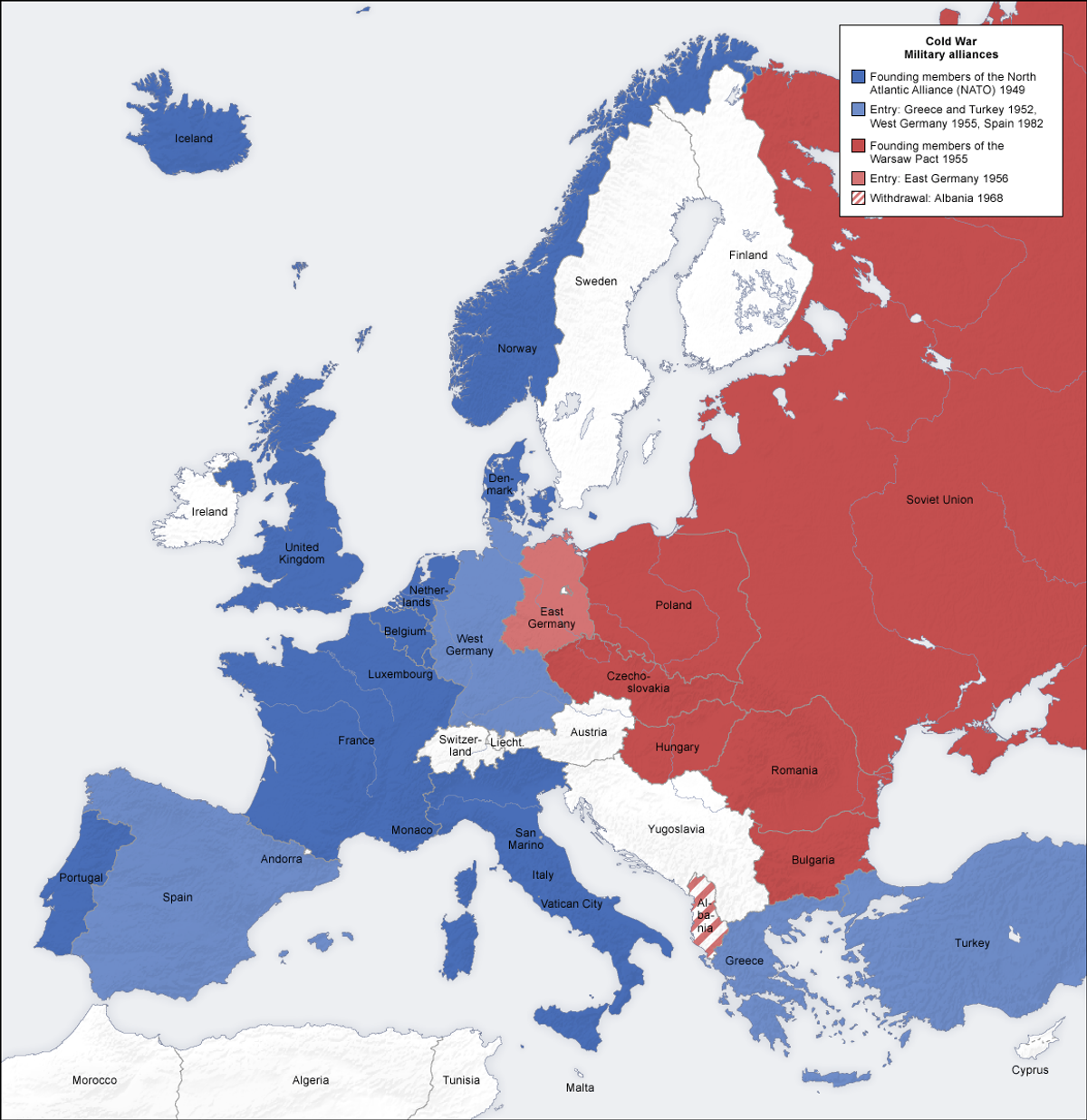
北约(蓝)与华约(红)的对峙格局;1991 年苏联解体后华约瓦解,这一联盟地图成为冷战终结的"遗照"。来源:Wikimedia Commons(San Jose)/ GFDL + CC BY-SA 3.0。
主线串讲 · 史学解释的三条路线
| 流派 | 核心论点 | 代表 |
|---|---|---|
| 保守派(西方压力取胜) | 里根/撒切尔的军事—经济施压拖垮苏联;SDI 与"position of strength"迫使戈氏让步。 | 里根主义叙事 |
| 自由派(苏联内部崩溃) | 体制内在经济危机与民族主义自发崩溃;西方并未主动"赢",戈氏也未料到速度。 | Source O(English 2005) |
| 综合 / "意图—结构"派 | 西方压力 + 戈氏新思维 + 人民压力合力;戈氏贡献"primary and absolutely crucial",西方"secondary"。 | Zubok(Source P)、Westad(Source Q)、Gaddis、教材 Unit summary |
→ 考试写此题,最稳是"综合派":经济问题是根本背景条件,但 1989 年的实际终结由"新思维 + 人民压力"直接驱动。直接引用 Gaddis/Zubok/Westad 可提深度,但 Mark Scheme 注明"reference to named historians not expected"——不引不扣分,引须准确。
📖 史料 · Source P(Vladislav Zubok, 2005)
"戈尔巴乔夫的抉择使对抗'irrelevant';里根、老布什等西方领导人的贡献'secondary',戈氏贡献'primary and absolutely crucial'。"
→ 支撑"综合派":西方压力是次因,戈氏主动转向才是主因。
📖 史料 · Source Q(Odd Arne Westad, 2005)
"戈氏的伟大在于'上任不久即认清诸多趋势,并有勇气付诸行动'。"
→ 与 P 互证:强调戈氏个人的"认知 + 行动"是冷战终结的不可省略变量。
深挖 · 写 25 分题的"相对重要性"题眼
题目的真正问法:"most significant factor"(最显著因素)。Section B 的 L5 要求不是"罗列因素",而是评估各因素的相对重要性(evaluate their relative significance)。常见失分:
- ❌ 只写叙述、不比较"most significant"——必掉到 L3 以下。
- ❌ 把"经济问题"与"新思维"割裂:高分段应指出二者因果纠缠(经济压力 → 戈氏被迫裁军 → 新思维 → 放弃勃列日涅夫主义)。
- ❌ 把柏林墙当"因"而非"果":教材 Skills Builder 明确"fall of the Berlin Wall was a result rather than a cause"。
- ❌ 混淆时间范围:题目限定 1985–90,勿大量写 1991 苏联解体(可作尾声,主论证落在 1985–90)。
⚠️ 易错:别只答"经济最重要"就收尾。L5 必须论证"若无经济崩溃,新思维是否仍会放弃勃列日涅夫主义?""若无新思维,经济问题是否足以自行终结冷战?"——这才是"relative significance"的得分点。
课后真题四件套 · Ch7-4(真题 202501 Sec B Q3 · 25 分)
① 题目(原题)
How far do you agree that, in the years 1985–90, the most significant factor in bringing the Cold War to an end was the impact of economic problems within the USSR?(25 分 · AO1 知识与分析 + AO2 判断与评估)
② Mark Scheme 指示性内容(双向 · 官方)
- 「同意」侧(苏联经济问题是主因):
- 几十年中央化后的经济停滞,使 80 年代末苏联不得不承认:无力负担维持其冷战地位所需的技术发展。
- 苏联生活水平总体下降,加上戈氏改革抬升的期望,加剧不满,迫使苏联专注国内政策而非冷战。
- 持续的阿富汗入侵 + 切尔诺贝利危机(1986)严重耗尽财政,使其更难在东欧维持勃列日涅夫主义。
- 苏联国内经济问题使经互会(Comecon)国家因对苏投资与贸易减少而受损,从而促使东欧集团"向西看"。
- 「其他因素更重要」侧(削弱"经济主因"论):
- 西方领导人与戈氏建立更积极的外交关系,营造可谈判氛围。
- 美国对苏"军事—技术优势",使里根与老布什能"从实力地位"制定政策与谈判,并为美国公众接受。
- 1985.3 戈氏就任;早期即重构外交政策(会见北约领导人与里根、对东欧"现实")。
- 戈氏改革引发的政治问题 + 苏联内部民族主义增长,损害政治稳定,削弱其维持冷战的能力。
- 东欧共产主义瓦解(源于 80 年代初波兰,尤以东德事件为甚)动摇了欧洲冷战敌对的根基。
- 美苏之外领袖的个人贡献:撒切尔、邓小平、教皇约翰·保罗二世。
- (结语:"Other relevant material must be credited."——合理补充均给分。)
- Level 5(21–25 分)描述:持续分析关键特征间关系;精确选取并充分运用知识以完全回应焦点;确立并应用有效评判标准,在得出总体判断时评估各因素的相对重要性;结构良好、逻辑连贯、表达精确。
③ 中文思路(冲 L5 结构)
引言:明确表态 + 提出评判标准(何谓"most significant"——是否触发连锁、是否具必然性、是否其他因素的必要条件)。
经济主因段(2–3 段):用 MS 四点(停滞/生活水平/阿富汗+切尔诺贝利/经互会)展开,量化具体化(400 亿/年海外负担、80 亿/年阿富汗)。
其他因素段(2–3 段):新思维与不干涉(必要前提)、里根/SDI 实力地位、东欧民族主义与人民压力、军控 INF/START;每段点出与"经济"的关系。
相对重要性权衡(关键):论证"若无经济崩溃,新思维是否仍会放弃勃列日涅夫主义?""若无新思维,经济问题是否足以自行终结冷战?"。
结论:回扣题目措辞,给有层次判断(经济是根本背景,但 1989 实际终结由新思维+人民压力直接驱动)。
④ 英文 EXEMPLAR(L5 水准 · 约 480 词)
To call economic problems "the most significant factor" in ending the Cold War between 1985 and 1990 is defensible only with an important qualification: Soviet economic weakness was the essential background condition that made ending the conflict possible, but the proximate cause of the Cold War's actual termination was Gorbachev's "new thinking" acting upon that weakness. The two cannot be separated, and to elevate either alone to "most significant" distorts the story.
The economic case is strong. Decades of central planning produced stagnation by the 1980s; the USSR could no longer afford the technological competition that the Cold War demanded. Living standards stagnated while Gorbachev's reforms raised expectations, deepening discontent and forcing the leadership to focus inward. The Afghan war — over 15,000 dead and some $8 billion a year — and the Chernobyl disaster of 1986 drained a treasury already under strain, making it harder to sustain the Brezhnev Doctrine in Eastern Europe. Crucially, the same weakness hurt the USSR's allies: as Soviet investment and trade with the Comecon states fell, those regimes looked west. In this sense the mark scheme is right that economic problems "made it possible" to contemplate an end to confrontation.
Yet economic distress alone did not end the Cold War; it made reform necessary, not its direction certain. The decisive intervening variable was Gorbachev's new thinking — his abandonment of the Brezhnev Doctrine, his willingness to negotiate (Geneva 1985, Reykjavik 1986, the INF Treaty of 1987), and his refusal to use force in 1989. Zubok argues Gorbachev's contribution was "primary and absolutely crucial," with Western leaders' roles "secondary." Without that choice, an economically weakened USSR might have produced another Brezhnev-style crackdown rather than the peaceful revolutions of 1989. The fall of the Berlin Wall and the collapse of communist rule in Poland, Hungary, Czechoslovakia and Romania were driven by popular pressure and nationalism that Gorbachev declined to suppress.
Western pressure remains relevant but subsidiary. Reagan's SDI and the broader military-technological competition strained Soviet finances and strengthened the case for negotiation "from a position of strength"; Thatcher and the Pope shaped the moral climate. But these were accelerants, not the engine. As the mark scheme notes, other factors — Gorbachev's early foreign-policy reorientation, internal nationalism, and the erosion of the Cold War's European foundations — all contributed, and credit is due for any relevant material.
In weighing relative significance, the economic crisis was necessary but not sufficient. It created the window; Gorbachev's agency and the peoples of Eastern Europe walked through it. The most significant factor in bringing the Cold War to an end — the actual events of 1989–90 — was therefore the combination of structural Soviet weakness with a leadership willing to act on it. I would rank economic problems as the deepest cause and new thinking as the most immediate, with neither sufficient alone. To answer the question strictly: economic problems were the most significant underlying factor, but not the most significant proximate one.
⑤ 自检清单
- ☐ 引言有没有提出"评判标准"(underlying vs proximate / 必要条件)?
- ☐ 有没有用 MS 的经济四点并量化(阿富汗/切尔诺贝利/经互会)?
- ☐ 有没有论证"经济与新思维的因果纠缠"(而非割裂)?
- ☐ 有没有评估"相对重要性"(relative significance),而非只罗列?
- ☐ 时间范围是否守住 1985–90(1991 仅作尾声)?
- ☐ 结论是否回扣题目措辞、给有层次判断?
拓展阅读 · 全册收尾
- 教材 Unit 8 Unit summary:西方经济压力 + 戈氏新思维 + 放弃勃列日涅夫主义 + 人民压力 + 1989 军控协议,共同终结冷战;1991 苏联正式解散 = "西方胜利"。
- Odd Arne Westad《The Cold War》(2017 版):关于"戈氏认清趋势并有勇气行动"的综合论断,适合做结论段的权威引述。
- 复习建议:把 Ch7 四讲串成一条链——新思维(7-1)→ 东欧不干涉(7-2)→ 德统/苏解(7-3)→ 综合辩论(7-4),再用 202501 Q3 做 25 分限时模考。