Ch3-1 · 苏联扩张与核时代:原子弹、中共胜利、氢弹与 NSC-68
Superpower Relations and the Cold War, 1944–90 — Unit 3: The Cold War in the 1950s
第 1 / 5 讲 1949 苏联原子弹 · 中共胜利 1950 NSC-68 · 1952–53 氢弹 教材 Steve Phillips《A World Divided》Ch3一、先搞懂这几个词
苏联首颗原子弹 1949
中共胜利 1949
氢弹 H-bomb
NSC-68
卫星国 Satellite states
缓冲国 Buffer state
二、背景链:苏联为什么"扩张"?
读这条链要抓两点:① 苏联的"扩张"既是意识形态输出,更是安全缓冲需求(历史上两度被德入侵);② 1949 是真正的转折点——原子弹 + 中共胜利双重打击,让美国从"经济遏制"转向"全面军事对抗"。
三、地图:东欧卫星国带(Eastern Bloc)
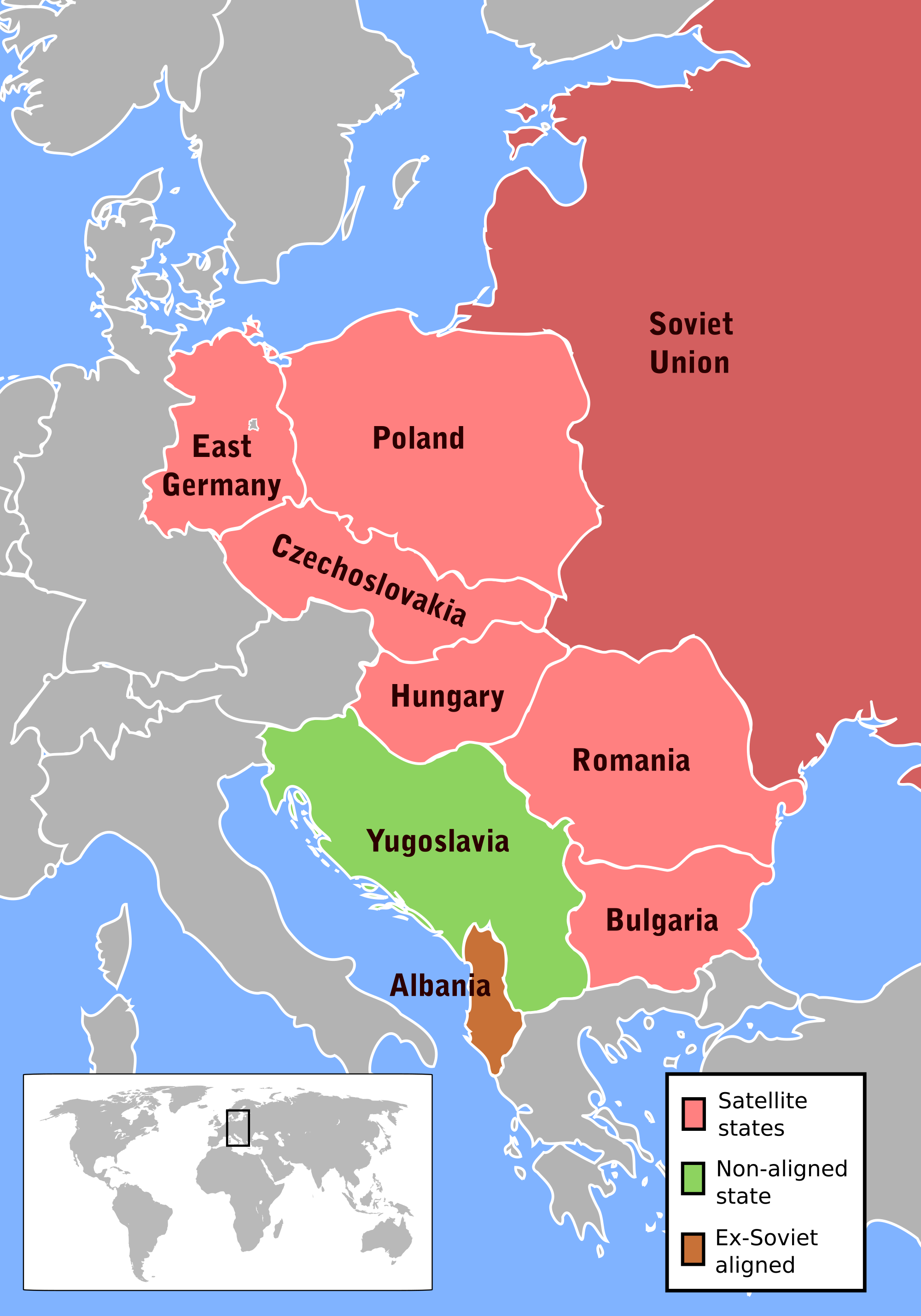
红色为苏联势力范围内的东欧卫星国(Eastern Bloc)。地图直观展示苏联在西欧与本土之间建立的"缓冲带"。图源 Wikimedia Commons(Goldsztajn, CC BY-SA 3.0)。
读图要点
- 缓冲逻辑:从波罗的海到巴尔干,苏联在西边一圈布满亲苏国家,目的是让任何西方进攻都先打在这些"缓冲国"上,而不是苏联本土。
- 与西欧对称:这张图右边(西欧)是民主与市场体制,左边(东欧)是共产主义与计划体制——这就是"铁幕(Iron Curtain)"的地理写照(丘吉尔 1946 演说已预言)。
- 下一课铺垫:朝鲜战争(Ch3-2)会展现共产主义在远东的扩张,与这张欧洲图形成"全球冷战"的全景。
四、四大事件详解
1. 苏联原子弹 1949:核垄断终结
教材指出:美国从 1945 到 1949 年独占核武。苏联的保密加上斯大林、赫鲁晓夫刻意夸耀核能力,加剧了美国"必须保持领先"的焦虑。原子弹不再是美国独有筹码,双方都开始把核优势当成安全保障——这为后来的军备竞赛埋下种子。
⚠️ 注意:斯大林其实把原子弹更多地当威慑筹码(bluff),认为其巨大破坏力使其不太可能在欧洲实际使用。但美国的"核威慑"态度反而强化了斯大林对西方的不信任——威慑与误判相互放大。
2. 中共胜利 1949:冷战扩展到远东
为什么共产党赢了?
- 国民党腐败、脱离民众;共产党在根据地分田、提产,赢得农民支持("言行一致")。
- 二战严重削弱国民党(日军主攻其沿海控制区),共产党据守内陆山区,受损较小。
- 1945 年日本战败后中国权力真空,共产党迅速填补。
对美国意味着什么?
毛泽东 1949 年 10 月建政"在美国引起震动"(shock waves)。但在华盛顿看来,这并不意外——它被视为"斯大林在远东的杰作",是苏联扩张的一环。
随后 1950 年 2 月中苏同盟签订,共产主义形成"欧洲+亚洲"的连片态势,美国深感威胁。
3. 氢弹 H-bomb:军备竞赛升级
苏联原子弹刺激美国加速研发更恐怖的武器:1952 年 11 月美国试爆氢弹;苏联借助间谍网络情报,1953 年 8 月就造出自己的(教材称"不到一年")。到 1955 年双方都拥有氢弹,其破坏力远超广岛原子弹。
教材点明:美国决定研发氢弹,正是被1948–49 柏林危机、1949 中共胜利、1950 朝鲜战争三件事共同"逼"出来的——苏联随之也研发自己的"超级炸弹"。每一方都以对方为借口扩军,形成螺旋式对抗。
4. NSC-68(1950):美国全面扩军
1950 年代初,许多美国人觉得"正在输掉冷战"。这种不安全感直接塑造了外交政策。杜鲁门命国家安全委员会出具报告,即 NSC-68。它把苏联动机"妖魔化",并主张美国须大规模重整军备。
该报告本因朝鲜战争(1950.6)才真正落地——战争成了"苏联扩张"的"证据",让扩军建议获得合法性。可以说,NSC-68 把冷战从"经济遏制"推到了"军事全面对抗"。
⚠️ NSC-68 与杜鲁门主义(1947)一脉相承,但量级不同:杜鲁门主义是"援助希腊土耳其"的局部承诺,NSC-68 是"永久、全域、军事化"的战略转向。
五、课堂史料(Source A / B)
参考答案
参考答案
参考答案
参考答案
六、📖 拓展阅读
① 美国核垄断为何仅 4 年就被瓦解?
1945 年 7 月美国在新墨西哥试爆首颗原子弹、8 月投于广岛长崎,西方情报界普遍估计苏联要 10–20 年才能造出。但 1949 年 8 月 29 日苏联在塞米巴拉金斯克试爆首颗“RDS-1”(美方代号“Joe-1”),杜鲁门于 9 月 23 日被迫公开承认,西方震动。
原因一:倾国之力。斯大林把原子弹视为国家安全生命线,资源极度倾斜,甚至由内务部直接接管核计划,举国体制下进度远超西方预期。
原因二:间谍网络。英国物理学家克劳斯·富克斯(参与美国曼哈顿计划与氢弹早期设计)自 1943 年起向苏联输送核心数据;罗森伯格夫妇、唐纳德·麦克林等人也提供情报,使苏联少走大量弯路。
原因三:高效情报协调。苏联情报机关“第一总局”统筹各渠道,把零散情报快速转化为工程指引。
这提醒我们:核垄断的终结不是“苏联突然变强”,而是美国核秘密被系统性渗透的结果,也预示了日后谍战将成为冷战隐形主线。
② 中苏同盟 1950 :《中苏友好同盟互助条约》全流程
一、前奏(1949)。1949.1.30–2.8 斯大林派政治局委员米高扬(A. Mikoyan)秘密飞抵西柏坡,与毛敲定建交、经援与未来条约框架——这是毛苏最高层首次直接对接。1949.10.1 建国,10.2 苏联成为第一个承认新中国的国家。但斯大林并不急于签新约:1945 年旧约对苏极有利(旅顺驻军、大连港、中长铁路),且他担心公开结盟会把苏联拖入中美冲突、影响对日和约。
二、莫斯科僵局(1949.12–1950.1)。1949.12.16 毛抵莫斯科,参加斯大林 70 寿辰(12.21)。首次会谈斯大林冷淡,只愿“形式上”续旧约。谈判一度冻结,毛在斯大林郊外别墅“静养”近两周,双方在“条约要不要重签”上顶牛。
三、转折(1950.1)。西方(英、印等)酝酿承认新中国 → 斯大林担心旧蒋条约自动失效 → 同意重签新约。1950.1.20 周恩来率庞大代表团抵苏,与苏外长维辛斯基谈判。
四、签约(1950.2.14)。毛、周与斯大林、维辛斯基在克里姆林宫签署《中苏友好同盟互助条约》,同时签两份附件:《关于中国长春铁路、旅顺口及大连的协定》《关于贷款给中华人民共和国的协定》,取代 1945 旧约,并互换照会确认蒙古独立地位。
五、核心条款(五条)。条约正文的关键承诺如下:
- ① 军事同盟:“一旦缔约国任何一方受到日本或与日本同盟的国家之侵袭因而处于战争状态时,另一方即尽其全力给予军事及其他援助”——“日本及日盟”矛头直指美国;
- ② 期限 30 年,期满前 1 年不废止则续 5 年;
- ③ 互不缔结反对对方的同盟、不参加反对对方的集团;
- ④ 对重大国际问题彼此协商;
- ⑤ 遵照平等互利、不干涉内政原则发展经济与文化合作,彼此给予一切可能的经济援助。
六、附件权益。中长铁路不迟于 1952 年末无偿移交中国;苏军自旅顺撤退(因朝战实际延至 1955.5);大连行政归中国;苏联贷款 3 亿美元、年息 1%,1950–1954 五年内以机器设备支付,中国以钨、锡、锑等战略物资于 1963 年底前还清;另设石油、有色金属、民航、造船 4 个合营公司,1955 年初由中国买回苏方股份。
七、意义与不平等痕迹。毛“一边倒”制度化,社会主义阵营正式成型(呼应 1947 共产党情报局、1949 经互会),并为朝鲜战争(Ch3-2)提供后方。但同盟并不平等:苏方将卢布比值定得很高、把人民币压得很低;苏军撤离东北时几乎拆走了全部可拆厂矿设备,只留空房,暴露出苏联大国沙文主义倾向。
八、伏笔。蜜月仅十余年即破裂——1956 苏共二十大起分歧公开,1960.7 苏联撤走全部在华专家,1969 珍宝岛兵戎相见;1979 五届人大决定条约期满不再延长。
③ 氢弹之后:"确保相互毁灭"(MAD)的雏形
苏联 1949 年原子弹刺激美国加速研发更恐怖武器。1950 年美国批准氢弹计划;1952 年 11 月 1 日在太平洋埃尼威托克环礁试爆首枚氢弹“常春藤麦克”(当量约 1000 万吨,为广岛的近 700 倍)。
苏联借助间谍情报,1953 年 8 月 12 日就造出自己的氢弹“RDS-6s”,比西方预期的“落后十年”又缩短。到 1955 年双方都拥有氢弹,破坏力达广岛的数百倍。
1957 年后洲际轰炸机与导弹使“隔洋互毁”成为现实。于是出现悖论:谁先动手都会被对方毁灭——这就是“相互确保毁灭(Mutual Assured Destruction, MAD)”。
该术语 1954 年由战略学者提出,后经基辛格等人系统化。它客观上“吓阻”了美苏直接热战,却让冷战长期僵在“核恐怖平衡”里;Ch5 的缓和(Détente)正是围绕如何管控这种平衡展开。
④ NSC-68 :冷战战略的军事化转折点
背景(1949–50 双重震撼)。苏联 1949.8 原子弹、中共 1949.10 建政、1950.1 前国务院官员希斯伪证罪定罪——美国陷入"丢失原子弹 + 丢失中国"的恐慌。国务卿艾奇逊令政策规划室新主任保罗·尼策(Paul Nitze)全面复审国家安全战略(接替偏温和的 NSC-20/4)。
文件本身。1950.4.7 完成、共 58 页的绝密报告《美国国家安全的目标与纲领》(United States Objectives and Programs for National Security),直至 1975 年才解密。
核心判断(三句话抓住)。
- ① 苏联受"敌意设计(hostile design)"驱动,被"一种新狂热信仰"鼓动,意图"将其绝对权威强加于全世界";
- ② 美苏"暴力与非暴力冲突已成常态(endemic)";
- ③ 苏联很快将拥有氢弹,时间窗口正在关闭,必须在数年内大幅扩军。
对策升级。遏制必须从政治/经济转向"全域、永久、军事化"对抗;建议国防开支从 1950 年约 130 亿美元提升到 500 亿(占 GDP 从 5% 升至 14.2%),扩建常规军、核武量产、全球海外基地与航母舰队;并主张增税、削减其他开支来筹资。报告拒绝回归孤立主义,也排除对苏预防性打击(认为无法摧毁苏进攻能力且会招致报复)。
为何成为"重点"。杜鲁门起初嫌太贵搁置;1950.6.25 朝鲜战争爆发,NSC-68 一夜成为政策蓝图,9 月获正式采纳。1951 财年军费从 130 亿跳到 480 亿。
内部反对。凯南本人反对此军事化转向,主张以政治经济手段遏制,认为会"自证预言"、加剧军备竞赛;国防部长约翰逊、苏联专家波伦也持疑。但朝战与国会"对共软弱"的指控迅速压倒了质疑。
意义。美国外交从"选择性遏制"硬核化为"全球军事遏制"——冷战分水岭文件,奠定此后 40 年军备竞赛与全球基地网,也催生艾森豪威尔 1961 警告的"军事—工业复合体"。艾森豪威尔上任后以"新貌(New Look)"削减总体预算,把重心从昂贵陆军转向更便宜的轰炸机与(后来的)洲际导弹,但并未否定 NSC-68 的基本前提。
⑤ 从杜鲁门主义到 NSC-68:遏制思想的升级
遏制(containment)思想源头是 1946 年 2 月 22 日乔治·凯南的“长电报”与 1947 年《外交》杂志 X 文章,主张以政治、经济手段围堵苏联扩张。
1947 年杜鲁门主义(3 月)只是局部承诺(援希、土),1948 年马歇尔计划将其经济化。这两步仍是“选择性、低成本”的遏制。
NSC-68 则是质变:把“遏制”从经济政治升级为“全域、永久、军事化”对抗,并预设苏联本性邪恶、冲突不可避免。
值得注意的是,凯南本人反对这种军事化转向,认为会加剧军备竞赛——他与尼策的路线分歧,预示了日后美国对苏战略的反复。这条线索说明:冷战的“硬化”不是一日之事,而是 1947→1950 逐步升级的结果,杜鲁门主义是起点,NSC-68 是终点形态。
⑥ 苏联"扩张"的安全逻辑:为什么它总觉得不安全
历史记忆:两度被德国入侵。俄国在一战东线、二战“巴巴罗萨”中两度惨遭德国入侵(后者死亡逾 2700 万),加之一八一二年拿破仑、蒙古西征,使俄国形成“无天然屏障、必须缓冲”的地缘 paranoia。
缓冲国带。斯大林据此在本土与西方之间保留一圈“缓冲国”——波兰、捷克斯洛伐克、匈牙利、罗马尼亚、保加利亚、东德。这条“卫星国带”的本质是苏联的安全带,而非单纯的侵略。
答题要点。若只写“苏联想侵略”,会漏掉最关键的动机维度。这一点在 Ch3-4 华约、Ch7 东欧剧变里还会反复出现:东欧国家既是苏联的盾牌,也是其最脆弱的软腹。
⑦ 英国原子弹与"第三核力量"
英美共享的破裂。二战中 1943 年“魁北克协定”英美曾承诺共享核技术,但 1946 年美国《麦克马洪法案》禁止外传,英国愤而独立研发。
英国成为第三核国。1952 年 10 月 3 日,英国在澳大利亚蒙特贝洛群岛试爆首枚原子弹“飓风”,成为第三个核国家;1957 年又试爆氢弹。法国则在 1960 年 2 月 13 日于撒哈拉试爆“蓝跳鼠”跟进。
拥核的动机。英国既为维持“大国地位”,也意在摆脱对美国核保护伞的完全依赖;戴高乐更在 1966 年退出北约军事一体化以示独立。
对冷战的意义。核扩散从“两极”走向“多极”,日后还催生了《不扩散核武器条约》(NPT, 1968)的谈判——这是 Ch3-1 之后二十年核政治的伏线。
⑧ "丢失中国"与美国内政:麦卡锡主义全貌
土壤。1949.9 苏联核试、1949.10 新中国、1950.1 希斯案定罪,叠加杜鲁门 1947 年《联邦雇员忠诚调查计划》(近 500 万公务员填表、2.5 万起进一步调查,仅 500–600 人被炒、无一人被起诉),反共 paranoia 已成气候。
麦卡锡其人。约瑟夫·麦卡锡(1908–1957),1946 当选威斯康星州参议员,前期默默无闻。1950.2.7(或 2.9)在西弗吉尼亚惠灵(Wheeling)对共和党妇女演说,挥舞"名单"称国务院内有 205 名共产党人——数字后变 81、57,从未出示。他点名中国专家拉铁摩尔(Owen Lattimore)为"头号苏联间谍"。
Tydings 委员会。参议院组成特别委员会调查,结论麦卡锡所列 9 名国务院雇员均非共党,斥其名单为"欺诈与骗局(fraud and hoax)"。但麦卡锡已借此跃上全国头条。
"麦卡锡主义"一词的诞生。1950.3.29《华盛顿邮报》漫画家 Herbert Block 发表讽刺漫画,首创 "McCarthyism" 一词。同年 6.1,共和党女参议员 玛格丽特·蔡斯·史密斯发表《良知宣言》,呼吁拒斥"以指控代替审判",有 7 名共和党人联署。
巅峰(1952–54)。1952 共和党赢参院,麦卡锡任政府运作委员会主席及其常设调查小组主席,聘 26 岁的罗伊·科恩为首席顾问(曾起诉罗森伯格夫妇)、罗伯特·肯尼迪短暂任职后因与科恩冲突辞职。他攻击前国务卿马歇尔为"叛徒"、艾奇逊为"红色院长",并借"中国通"清洗(谢伟思、戴维斯等最懂东亚的外交官被整肃,导致朝战/越战决策失智)。1953 罗森伯格夫妇电椅处决;HUAC 好莱坞黑名单("好莱坞十君子"1947 起)持续扩大。
垮台。1954.4–6 陆军—麦卡锡听证会电视直播 36 天、4000 万观众。6.9 陆军律师韦尔奇怒斥:"参议员,你到底有没有廉耻?(Have you no sense of decency?)"会场自发鼓掌;同月 Murrow 在《See It Now》做揭批专题。1954.12.2 参议院以 67:22 通过谴责(censure)决议。麦卡锡失势,1957.5.2 死于酒精相关疾病。
影响(三层)。
- ① 国内:政治迫害常态化、寒蝉效应,LGBTQ+ 群体也以"道德堕落"为由遭清洗;"忠诚调查"扩大,"麦卡锡主义"成为"无证据政治迫害"的专有名词。
- ② 外交:对苏"绝不妥协"被锁死为政治正确——任何缓和主张在 1950 年代都是毒药,对华承认被封杀至 1972 尼克松访华才破冰。
- ③ 文化长远:anti-communism 成政治正确底色,红色恐慌叙事深嵌美国政治文化至今。
七、⚠️ 易错提醒
答题时这三点最容易丢分
- ① 苏联"扩张"≠ 单纯侵略:要同时写出意识形态 + 安全缓冲两层动机,否则论证单薄(教材强调苏联两度被德入侵的创伤)。
- ② 时间线别混:原子弹 1949.8 → 中共 1949.10 → NSC-68 1950.4 → 朝鲜战争 1950.6 → 氢弹 美 1952 / 苏 1953。顺序错了整段因果崩。
- ③ 别把 NSC-68 当"宣战":它是一份政策报告(blueprint),靠朝鲜战争才真正执行;其意义是"战略转向"而非具体军事行动。
八、真题四件套:202601 Q1(冷战发展 1943–50)
题目(Edexcel Paper 4,2026 年 1 月场 · Section A,25 分)
How far do you agree with the view that in the development of the Cold War, in the years 1943–50, the decisive year in the breakdown of relations between the USA and the USSR was 1945?
Explain your answer using Extracts 1 and 2 and your knowledge of the issues related to this controversy. (25)
📋 Mark Scheme 核心要点(指示性内容)
支持"1945 决定性"的论证:
- 波茨坦分歧(1945.7):东欧、德国问题无法调和,合作基础破裂。
- 杜鲁门的不信任:接替罗斯福后对苏强硬,放弃继续合作。
- 美国原子弹(1945.7 试爆):军事经济优势使美国对苏更强硬。
"其他关键年份"(用来论证 1945 非唯一决定性):
- 1944(对德胜利在望,联盟目标消失)
- 1946(铁幕演说,公开对立)
- 1948(柏林封锁,首个直接危机)
- 1949(柏林封锁余波 + 北约成立 + 苏联原子弹 + 中共胜利——本课覆盖)
评分要求:须分析两份 Extract 的作者立场并得出有理据的结论,不能只罗列事实。
💡 中文思路(如何搭一篇 25 分 essay)
立场建议:部分同意——1945 是"破裂开端"但非"唯一决定性年份",1947–49 的连锁事件同样(甚至更)关键。
段落规划:
- 引言:明确"多大程度同意",点出 1945 是分水岭但后续深化。
- 同意面(1945):用 Extract 1——波茨坦分歧、杜鲁门不信任、原子弹催生强硬。冷战的"种子"在此埋下。
- 不同意面(1947):用 Extract 2——1946 仍有善意,1947 才因希腊内战、杜鲁门主义、马歇尔计划真正决裂。Extract 2 本身就是反驳"1945 决定性"的证据。
- 不同意面(1948–49,结合本课):柏林封锁(1948–49)、北约成立(1949.4)、苏联原子弹(1949.8)、中共胜利(1949.10)——这些让对抗从"政治分歧"变成"军事—核对抗"。特别要写:1949 双重冲击催生 NSC-68(1950) 与氢弹竞赛,冷战被永久军事化。
- 结论:1945 开启破裂,但 1947–49 才是"定型"期;决定性年份不止一个,1945 是起点而非终点。
高分关键:把本课知识点(原子弹 / 中共 / NSC-68 / 氢弹)当作"1945 之后深化对抗"的论据,正好呼应题面、又展示你学了 Ch3-1。
📝 英文 EXEMPLAR(约 1200 词 · 参考范文)
It is partly true that 1945 was the decisive year in the breakdown of US–Soviet relations, but the argument overstates the uniqueness of that year. The Potsdam Conference of July 1945 did reveal irreconcilable differences over Eastern Europe and the future of Germany, and Truman's distrust of the USSR, compounded by the successful US atomic test during the conference, did push the USA towards a harder line. Yet to label 1945 as "decisive" ignores that co-operation had not fully ended then, and that the most concrete breaks in relations came in 1947–49 — a period that included the communist takeover of China, the Soviet atomic bomb, the formation of NATO and the drafting of NSC-68. A balanced judgement must treat 1945 as the beginning of breakdown, not its completion.
The case for 1945 rests largely on the Potsdam summit and the atomic bomb. As Extract 1 (Ambrose) shows, "irreconcilable differences" surfaced immediately at Potsdam: agreements on Germany were marginal, and"There was no possibility of resolution" on reunification. Truman returned with "an attitude of mistrust," abandoning Roosevelt's attempt at collaboration. Crucially, the US atomic test in July 1945 gave Truman "a feeling of awesome power," encouraging a tougher stance. In this sense 1945 was decisive: it marked the moment the USA first possessed both the means and the mindset to confront the Soviet Union rather than accommodate it. The ideological and strategic foundations of the Cold War were, in effect, laid in 1945.
However, Extract 2 (Laqueur) directly qualifies the "1945 decisive" view. It notes that "throughout 1946, there was still much US goodwill towards the USSR," and that leading American politicians still favoured "moderation." If 1945 had truly ended collaboration, such goodwill in 1946 would be inexplicable. The real rupture, Laqueur argues, came only in 1947: the Greek civil war (taken "with Soviet knowledge"), the British retreat from Greece and Turkey, the Truman Doctrine, and the Marshall Plan. By June 1947 the USSR "decided not to" participate in the recovery plan, and "events in 1947 brought any chance of collaboration… to an end." This strongly suggests that 1947, not 1945, was the year relations were finally and irreversibly broken.
The years 1948–49 then turned a political breakdown into a military and ideological one. The Berlin Blockade (1948–49) was the first direct confrontation, proving that co-operation was impossible in practice, not merely in spirit. NATO's formation in April 1949 institutionalised the Western alliance and, for the first time, committed the USA to a peacetime military tie in Europe. Just months later, in August 1949, the Soviet Union exploded its own atomic bomb at Semipalatinsk — ending the American nuclear monopoly four years earlier than expected and injecting a genuinely new, existential dimension into the rivalry. The same year saw Mao Zedong proclaim the People's Republic of China, extending communism to the world's most populous state and, in February 1950, sealing the Sino-Soviet Alliance. For American policymakers these were not the consequences of 1945; they were fresh shocks that convinced many they were "losing the Cold War."
That sense of vulnerability produced the most consequential shift of the early Cold War: NSC-68 (April 1950). Far from being rooted in 1945, NSC-68 responded to the dual 1949 shocks — the Soviet bomb and the loss of China — and to the outbreak of the Korean War in June 1950. As the document itself declared, the Soviet Union was "animated by a new fanatic faith… [seeking] to impose its absolute authority over the rest of the world," a framing that justified wholesale US rearmament. The hydrogen bomb race that followed — the USA in November 1952, the USSR by August 1953 — would have been unthinkable in 1945, when only one side held even an atomic weapon. These developments, all post-1945, did more to "decide" the shape of the Cold War than Potsdam did.
In weighing the two extracts, Ambrose (Extract 1) represents the "1945 decisive" school, locating the origins of breakdown in the personalities and power disparities of 1945. Laqueur (Extract 2) implicitly challenges this by showing that rupture was a process, not a single moment, and that 1947 was the genuine turning point. Neither extract, however, accounts for the nuclear and global dimensions that 1948–50 supplied. A judgement based only on 1943–47 would miss precisely the developments — Soviet atomic capability, communist China, NATO, NSC-68 — that made the Cold War total rather than partial.
In conclusion, 1945 was decisive in the sense that it opened the breach: Potsdam exposed the divide and the atomic bomb altered the balance of resolve. But it was not the decisive year in the breakdown of relations, because relations were not yet broken in 1945–46, and because the structures of confrontation — military alliances, nuclear rivalry, global ideological competition — were built in 1947–50. The stronger claim is that 1945 began the Cold War, while 1947–49 completed it. To fix on 1945 alone is to mistake the first crack for the collapse.