Alevel 历史 · Ch1-4 三巨头会议:德黑兰 · 雅尔塔 · 波茨坦
Superpower Relations and the Cold War, 1944–90 | Ch1 The seeds of conflict 1917–44(第 4 / 4 讲 · 本章收官)
90 分钟:讲解 40′ + 刷题 50′(含 Ch1 综合限时 Essay) 教材:Steve Phillips, A World Divided 大纲定位:W1 周四(8/27)本课目标 · Key Questions
- 掌握三次峰会(Teheran 1943 / Yalta 1945 / Potsdam 1945)的时间、人物、协议、分歧,能做三会对比。
- 理解 1945 年间同盟气氛为何急剧恶化——领导人更替、德国战败、原子弹三重变量。
- 分析雅尔塔协议中的模糊措辞如何为战后争执埋雷,尤其是波兰问题。
- 综合全章(Ch1-1 至 Ch1-4)完成一篇限时 Essay:意识形态、领导人个性、国家利益,谁是冷战起源的主因?
教材核心设问:To what extent had relations broken down by the end of 1944? 本课把时间线推到 1945 年,给出答案:种子已备,但破裂不是必然——它是被一次次会议、一个个决定推着发生的。
一、核心定义 · Key Definitions(点击展开)
Teheran Conference(德黑兰会议,1943.11–12)
Yalta Conference(雅尔塔会议,1945.2)
Potsdam Conference(波茨坦会议,1945.7–8)
Percentages Agreement(百分比协定,1944.10)
Declaration on Liberated Europe(解放欧洲宣言,1945)
Buffer zone(缓冲带)
Operation Unthinkable(不可思议行动,1945)
二、1945 年开局:三国想要什么
会议是桌子,桌面下是各自的算盘。进入三次会议前,先把三国 1945 年的心态摆清楚——这是理解会议成败的钥匙。
| 国家 | 战后目标 | 心态与筹码 |
|---|---|---|
| 苏联 | 安全保障(buffer zone)、重建国家、保留 1939 年条约所得(波罗的海、波兰东部等)、争取美国经济援助。 | 死亡超 2000 万、城市成废墟;20 世纪三度遭入侵的记忆使安全成为执念。红军实际占领东欧——既成事实是最大筹码。 |
| 美国 | 建立联合国、自由贸易与开放市场(欧洲复兴 = 美国商品市场)、限制苏联在东欧单边行动。 | Roosevelt 务实愿妥协,但他 1945.4 病逝;继任 Truman 被排除在战时外交之外、突然接位,加上国内反共压力,转向"铁拳"(Iron Fist)路线。 |
| 英国 | 维持大国地位、限制苏联、保住帝国与地中海利益。 | 国债三倍、经济破产,深知没有美国便无力制苏;Churchill 1945.7 大选落败,Attlee 接任。名义三强,实际已是配角。 |
考试提示:答"同盟为何破裂"时,先摆这张表——三国目标本来就难以兼容,会议只是把矛盾摆上了桌面。
三、德黑兰 1943:合作的第一次试探
- 首次会晤:三巨头此前从未同席。Stalin 迟迟不愿会面(怀疑英美想架空苏联),直到 1943 年战局明朗才成行。
- 主要成果:敲定 1944 年开辟第二战场(Operation Overlord,即诺曼底登陆)——这是 Stalin 呼吁两年的事;讨论波兰边界西移;苏联承诺在对德战争结束后对日参战。
- 气氛:总体合作。胜利在望,三方都还需要彼此。
- 但教材同时点出:"despite this level of cooperation, divisions remained between the three leaders"——分歧被胜利前景暂时盖住,没有解决。
提示:①可联系他早年的怀疑与对英法"祸水东引"的记忆;②选在苏联势力可达的中立地带,Stalin 不愿远行(也怕暗杀);④因为此时三方目标高度一致——尽快打赢德国,战后问题还都可以往后拖。
📖 拓展阅读:德黑兰会议的流程、细节与考点
会议流程
代号 "Eureka",1943 年 11 月 28 日至 12 月 1 日,会期 4 天。地点在苏联驻德黑兰使馆——Stalin 主场。正式全体首脑会议 3 场(11.28、11.29、11.30 下午 4 点各一场),外加 12.1 的三方政治会议;另有多场军事参谋会议及三方轮流主办的晚宴。
关键细节
- Roosevelt 住进苏联使馆:官方理由是因小儿麻痹症行动不便、使馆有电梯;深层原因是 Stalin 以此安排 NKVD 窃听美方房间,同时可避开疑似德国暗杀阴谋 "Operation Long Jump"(党卫军计划在德黑兰行刺三巨头,已被苏联情报破获)。
- 斯大林格勒剑:11.29 举行隆重仪式,英王乔治六世委托 Churchill 赠送一把铭刻"给斯大林格勒钢铁之心的人民"的长剑给 Stalin,表彰斯大林格勒战役。Sword of Stalingrad
- Churchill 69 岁生日宴:11.30 在 British Legation 举行,34 人出席。Stalin 举杯称 Churchill 为"my fighting friend";Churchill 说"England is getting pinker",Stalin 回敬"It is a sign of good health"——气氛融洽。
- Roosevelt 的"charm strategy":会前私下与 Stalin 会面试图拉拢,但"以个人魅力影响 Stalin"的策略未实质奏效——Stalin 在实质性问题上寸步不让。
会上重点(除第二战场外)
- Overlord 确定于 1944 年 5 月(实际 6 月 6 日发动),29 个师;苏联承诺同期发动"巴格拉季昂"攻势(1944.6.22——恰好是 1941 年德国入侵三周年纪念日)。
- 伊朗:发表《德黑兰宣言》承认伊朗主权,承诺战后撤军——但苏联直到 1946 年才在伊朗北部撤军,成为冷战早期的一次危机(伊朗危机 1946)。
- 土耳其:Churchill 希望土耳其参战打开巴尔干通道,Stalin 冷淡——苏联战后反而向土耳其施压要求海峡管辖权(1946 土耳其危机)。
- 芬兰:讨论芬兰退出战争条件(1944.9 芬兰单独媾和,比德国早两个月退出)。
- 法国地位:Stalin 最初反对承认法国为战胜国("法国对德国开过一枪?"),后让步——De Gaulle 未被邀请参加德黑兰,埋下法国对"美苏决定欧洲"的不满。
- 波兰:初步倾向Curzon 线为东界(把波兰东部划给苏联),西界从德国取得补偿——这是雅尔塔正式确认的预演。
与 Alevel 的关系
德黑兰在考试中通常考"三场会议中合作的高点"——需强调此时红军仍在苦战、美苏尚有共同敌人,协议务实而具体。常见题型:"德黑兰是否标志着冷战分歧的种子?"——答:已现波兰、东欧势力范围的苗头,但为次要议题,主流是"战时蜜月"。注意不要把德黑兰写成"破裂的开始"——那是事后视角。
四、雅尔塔 1945.2:合作的顶峰,也是埋雷之处
4.1 达成了什么
| 议题 | 协议内容 | 埋下的雷 |
|---|---|---|
| 联合国 | 决定建立联合国,当年 4 月 25 日旧金山制宪会议。 | 安理会否决权、成员国资格等细节未敲定。 |
| 德国 | 德国、柏林、奥地利分区占领(含法国占领区);赔偿"尽最大可能"支付。 | 赔偿总额与分账方式无细则 → 波茨坦继续吵。 |
| 东欧 | 「解放欧洲宣言」:被解放国家应举行自由选举。 | "民主""自由"没有定义权归属 → 双方各取所需。 |
| 波兰 | 边界大幅西移(苏联得东部、波兰从德国取得补偿);Lublin 政府吸纳伦敦流亡政府成员,随后举行自由选举。 | 红军已实际控制波兰——协议写在纸上,军队站在地上。 |
| 远东 | 苏联承诺德国投降后两三个月内对日作战,回报为南库页岛、满洲权益等。 | (后来原子弹改变了一切,见 4.3。) |
4.2 桌面下的现实
- Stalin 主场:雅尔塔在苏联境内克里米亚,远道而来的 Roosevelt 病入膏肓(两个月后去世),谈判地位此消彼长。
- 既成事实:苏军已横在东欧大地。Stalin 名义上答应"自由选举",但他的军队已在各国关键部门安插共产党人。
- Churchill 的后手:会后就命令军方起草对苏作战的 Operation Unthinkable——计划本身不现实,却暴露了西方的真实不安。
这句话值得背下来:宽泛宣言人人能签(algebra),一到算细账(arithmetic)分歧就藏不住——雅尔塔恰是一次"代数式"的成功,把"算术题"全部留给了波茨坦。
4.3 怎么评价雅尔塔
- 顶峰说:教材认为 Yalta–Potsdam 阶段"substantial progress was made"——联合国、分区占领都是实打实的成果,三巨头私人关系尚可。
- 埋雷说:所有关键措辞都是模糊的("free elections""民主政府"),苏联战后拒不兑现,西方由此得出结论:Stalin's word could not be trusted。
- 现实说:雅尔塔与其说"决定了"东欧命运,不如说承认了既成事实——红军在哪里,协议就写到哪里。
📖 拓展阅读:雅尔塔会议的流程、辩论焦点与考点
会议流程
代号 "Argonaut",1945 年 2 月 4 日至 11 日,会期 8 天。地点在克里米亚的里瓦几亚宫(Livadia Palace,沙皇尼古拉二世旧夏宫)。共 8 场正式全体会议。Roosevelt 住里瓦几亚宫并主持会议;Churchill 住沃龙佐夫宫——所有房间均被 NKVD 窃听。此时 Roosevelt 心血管病、高血压、心力衰竭极重,一年内瘦 30 磅,Leahy 将军称他"比以往更老更累";参会后不到 10 周(4.12)病逝。
重点辩论焦点
- 波兰边界(最激烈议题):东界确认基本沿 Curzon 线(对波兰有 5–8 公里出入让步)。西界补偿至奥得河——争议在"东尼斯河 vs 西尼斯河"。英美倾向东尼斯河(较少德国领土给波兰),Stalin 坚持西尼斯河(让波兰吞下 600–700 万德国人的领土)。最终留待和平条约,但实际按 Stalin 方案执行。
- 德国赔偿:Stalin 开口 200 亿美元、半数归苏。Churchill 拒绝指定数字(怕重蹈凡尔赛覆辙)。Roosevelt 同意作"讨论基础",设赔偿委员会于莫斯科——总额从未敲定,波茨坦继续吵。
- 联合国安理会否决权:Roosevelt 推动五常一致原则(常任理事国对实质问题有否决权)。Stalin 要求 16 个加盟共和国均加入联合国(谋求更多票数),最终妥协为乌克兰、白俄罗斯 2 席——加上苏联本身共 3 票。
- 远东参战条件:Stalin 承诺德国投降后 2–3 个月内对日作战。条件:外蒙维持现状(实际承认外蒙独立)、南库页岛归还、千岛群岛移交、旅顺租借、大连国际化、中东铁路中苏共管——严重损害中国主权,国民政府事后被迫接受(《中苏友好同盟条约》1945.8.14)。
- 《被解放欧洲宣言》:Roosevelt 提案,承诺被解放国家举行自由选举——后来成为西方评判 Stalin 违约的标尺。
百分比协定与雅尔塔的关系(考试高频)
1944 年 10 月莫斯科会议(代号 Tolstoy),Churchill 在纸条上写:罗马尼亚 90% 苏 / 10% 英、希腊 90% 英 / 10% 苏、南斯拉夫 50/50、匈牙利 50/50、保加利亚 75% / 25%。Stalin 蓝铅笔勾过,后 Eden 与 Molotov 微调为保、匈 80/20。此协定从未在雅尔塔正式提及,但其精神已为雅尔塔默认——Stalin 理解为可全面控制其比例区,Churchill 理解为仅外交往来。考试常考"百分比协定是否为冷战起点":传统派(Resis)认为该协定出卖东欧;修正派(Roberts)反驳——苏联部分遵守了希腊承诺(未干预希腊内战),并非完全失控。
Roosevelt 健康与"Yalta betrayal"叙事
Roosevelt 1945.4.12 病逝,副总统 Truman 接任——他被排除在战时外交之外,突然接位。美国保守派后来炮制 "Yalta betrayal" 叙事,认为 Roosevelt 病弱被 Stalin 欺骗、出卖东欧。修正派(LaFeber、Gaddis)反驳:红军已占领东欧,Roosevelt 核心目标(UN + 苏联对日参战)达成,波兰本无可挽回。后修正派进一步指出:雅尔塔协议的"蓄意模糊"才是冷战起因——"自由选举"无执行机制,双方各取所需。
与 Alevel 的关系
雅尔塔是最高频考点。题型:(1)"Yalta 是否'叛卖'?"——需区分当时的评价(西方舆论视为成功,Roosevelt 回国受民众欢迎)与事后的评价(冷战 hindsight);(2)"雅尔塔是合作的顶峰还是破裂的开始?"——答:是顶峰但措辞模糊埋雷,真正的破裂在 2 月到 7 月之间(德国战败 + 换人 + 原子弹三个变量集中爆发)。Stalin 在雅尔塔居高临下的"地主心态"和"algebra vs arithmetic"名言都值得引用。
五、波茨坦 1945.7–8:同盟的"严重降温"
5.1 五个月,换了人间
- Roosevelt 去世(1945.4),Truman 上台——他接任不到两周就跟苏联外长 Molotov 拍桌子,要求"必须遵守雅尔塔协议",用语被称"密苏里骡夫的语言";Molotov 抗议从没被人这么说话,Truman 答曰:履行承诺就不会再这样。
- 德国投降(1945.5)——同盟的共同敌人消失了。
- 会议开幕前一天(1945.7.16),美国原子弹试爆成功。
- 会议中途英国大选,Attlee 替换 Churchill。
- 教材总结:面对两位外交新手,"Stalin had a clear advantage"——三巨头中只有他从头走到尾。
5.2 吵了什么
| 议题 | 分歧 |
|---|---|
| 东欧/波兰 | 自由选举毫无兑现迹象:苏占波兰领土并入苏联、500 万德国人被驱逐出波兰西界(Oder–Neisse 线)以外,东欧各国共产党纷纷进入政府要职。Truman 越来越不满。 |
| 德国赔偿 | 苏联要高额赔偿、要"榨干德国";美英怕重蹈凡尔赛覆辙、怕德国经济崩溃。最后妥协:各占领区自取赔偿(苏联另从西区得部分工业设备)——等于默认德国经济分裂。 |
| 原子弹 | Truman 只轻描淡写地对 Stalin 提了一句"新式毁灭性武器",拒绝告知详情与投弹决定。Stalin 早已通过间谍知情,视"被瞒"为对战时盟友的深重羞辱;苏联随即加速自己的核计划(1949.8 成功)。 |
结果适得其反:原子弹没有让 Stalin 屈服,反而(1)会议后第 4 天投下广岛、第 2 颗后日本投降,苏联被排除出对日占领,对日参战的谈判筹码瞬间作废;(2)让 Stalin 确信美国想用核垄断讹诈——他把原子弹视为"a weapon of bluff",态度反而更硬。一弹双输,这是"原子外交"反效果的教科书案例。
5.3 三次会议对比表(建议背下)
| 德黑兰 1943.11 | 雅尔塔 1945.2 | 波茨坦 1945.7–8 | |
|---|---|---|---|
| 人物 | Roosevelt / Churchill / Stalin | 同左(Roosevelt 已病重) | Truman /(中途换 Attlee)/ Stalin |
| 背景 | 胜局初定,需协调作战 | 德国败局已定,安排战后 | 德国已投降,共同敌人消失 |
| 关键成果 | 第二战场定于 1944;苏联对日参战承诺 | 联合国;分区占领;自由选举原则;波兰西移 | 确认占领区;赔偿各自从本区取——几乎没有新共识 |
| 气氛 | 合作、试探 | 合作顶峰 + 模糊埋雷 | severe cooling(严重降温) |
| 变数 | — | Roosevelt 健康恶化 | 换两位领导人 + 原子弹 + 敌人消失 |
记忆钩子(PEER):People(换了人)、Elections(选举承诺落空)、Europe(东欧控制权)、Reparations(赔偿分账)——波茨坦四大吵点。
📖 拓展阅读:波茨坦会议的流程、辩论焦点与考点
会议流程
代号 "Terminal",1945 年 7 月 17 日至 8 月 2 日,会期 17 天。地点在柏林郊外的采齐林霍夫宫(Cecilienhof Palace)。共 13 场全体会议:7.17–7.25 开 9 场,中断 2 天等英国大选结果,7.28–8.2 续开 4 场。Truman 主持(唯一在任国家元首,Stalin 名义上非元首——最高苏维埃主席团主席是加里宁)。
重点辩论焦点
- 德国"五 D"原则:demilitarization, denazification, democratization, decentralization, deindustrialization——但去工业化程度未细化。Stalin 要狠(要"榨干德国"),英美克制(怕重蹈凡尔赛覆辙、怕德国经济崩溃)。
- 波兰西界 Oder-Neisse 线:确认为"临时"边界,待最终和平条约——实质承认 Stalin 既成事实。德国割让约 9.1 万平方公里(含西里西亚、波美拉尼亚),约 500–800 万德国人被驱逐出波兰西界以外("forced population transfer"——20 世纪最大规模的人口迁徙之一)。
- 东欧政府承认:Romania、Bulgaria、匈牙利政府问题——英美要求改组并选举,Stalin 拒绝;搁置到 Council of Foreign Ministers(外长会议)。
- 赔偿方案:放弃总额,改 "各占各区"原则——苏联从本区拆除工业设备,另可获西区 10–15% 设备交换本区农产品等。等于默认德国经济分裂。
- 日本问题:7.26 中英美发布《波茨坦公告》要求日本无条件投降(苏联尚未对日宣战故未签署)。Stalin 承诺 8.15 前对日宣战——实际 8.8 宣战、8.9 入侵满洲(8.6 广岛、8.9 长崎,两颗原子弹改变了一切)。
关键细节
- Truman 日记的变化:7.17 首会 Stalin 后写道"I can deal with Stalin. He is honest but smart as hell.";但没几天就转为"Tired of babying the Soviets"、"Russians only understand one language — how many armies have you got"——这是美国态度由妥协转向强硬的最直接证据。
- Stalin 的态度:被问到在柏林感受时,Stalin 答"Tsar Alexander got to Paris"——视占领为战利品,把苏联推进与沙俄扩张传统相联。
- 原子弹告知:7.16 新墨西哥 Trinity 试爆成功;7.18 Truman 与 Churchill 商定告知;7.24 会议休息时Truman"随意"对 Stalin 说美国有 "new weapon of unusual destructive force",Stalin 反应冷淡——其实早通过间谍 Klaus Fuchs 等掌握全部情报,会后即令核物理学家 库尔恰托夫"加紧工作"。苏联 1949.8.29 首次核试成功(Joe-1),比美国情报预期早了数年。
- 英国大选中断:7.5 投票(因海外军人票计票慢),7.26 宣布——Attlee 击败 Churchill。7.28 起 Attlee 携外相 Bevin 接替,会议氛围更冷峻——Churchill 事后说"会议进行到一半,我从主角变成了观众"。
与 Alevel 的关系
题型"波茨坦什么都没达成,对吗?"——不对。达成:Oder-Neisse 确认、五 D 原则、赔偿"各占各区"、Council of Foreign Ministers 成立、波茨坦公告。但确为"合作转向对抗的转折":(1) 三巨头仅 Stalin 为老人,Truman 新手上任强硬、Attlee 专注内政;(2) 共同敌人消失(德国已降),日本将降;(3) 原子弹打破实力平衡,美国有底气强硬;(4) 东欧自由选举承诺成空头支票。18 个月内冷战成形。答题时务必区分"达成的程序性成果"与"悬置的实质分歧"。
六、课堂史料训练
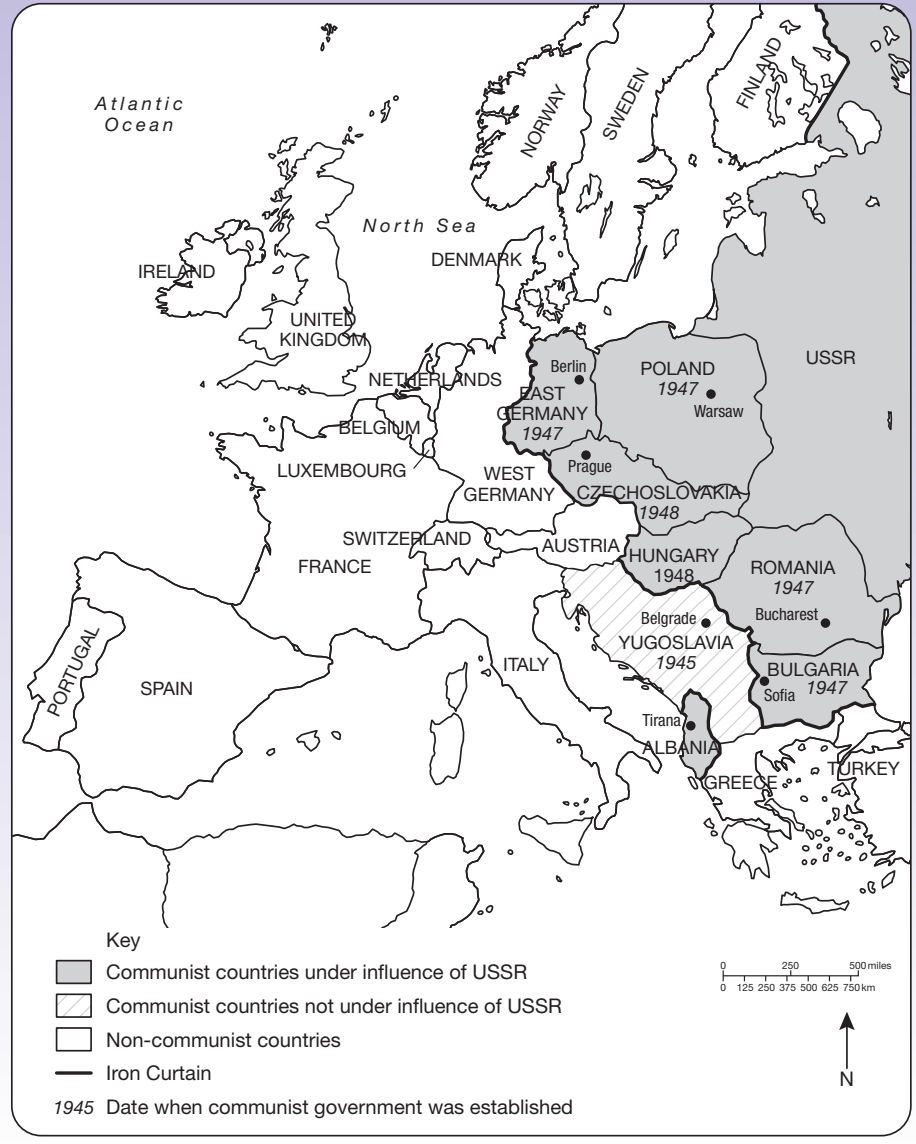
这张图是答"雅尔塔承诺是否被违背"类题目的黄金证据:题目问 agreement,你答地图显示的 timeline;题目问 interpretation,你用 ③ 的动机之争翻上去。
📌 三道设问参考回答(点击展开)
① Using the map, describe what happened to the governments of Eastern Europe between 1945 and 1947.
The map shows that between 1945 and 1947 every state in Eastern Europe came under Communist government, in a clear geographical sequence radiating outward from the Soviet border. Yugoslavia (1945) and Albania (1945) were the first, though their Communist parties had come to power largely through their own wartime partisan resistance rather than direct Soviet imposition. Bulgaria followed in 1945, then Poland in 1945, where a coalition dominated by the Soviet-backed Lublin Poles replaced the London government-in-exile. Romania saw a Communist-dominated government established in 1945–46 under Groza. By 1947 the process reached Hungary and Czechoslovakia—the latter often cited as the last 'genuine' coalition, where the February 1948 coup (not shown on this 1947 map) completed the process. The map thus captures the moment when the 'iron curtain' was still descending: by 1947 only Czechoslovakia retained a fragile pluralism, and the map's chronological layering makes plain that Soviet-style one-party rule was advancing westward year by year.
② How does this map challenge the agreements made at Yalta?
The Yalta Conference (February 1945) had produced the Declaration of Liberated Europe, in which the three powers pledged that liberated nations would be allowed to hold 'free elections' and form democratic governments of their own choice. This map is a visual record of that promise being broken: by 1947, none of the states shown had held genuinely free elections, and Communist parties—installed, backed, or coerced by the Soviet Red Army—monopolised power. The map therefore challenges the Yalta agreements in three ways. First, it shows that 'free elections' never materialised; where elections did occur (e.g. Poland's January 1947 referendum), they were manipulated. Second, the timeline demonstrates that the process was neither spontaneous nor coincidental: the dates of Communist takeover form a pattern that suggests deliberate Soviet orchestration, not the organic political evolution Yalta had envisaged. Third, the map reveals that by 1947 the 'ring of friendly states' Stalin had promised was in fact a ring of satellite regimes—precisely the outcome Churchill would label the 'iron curtain' in March 1946. The map is thus direct, if circumstantial, evidence that the Yalta framework had collapsed.
③ How useful is this map as evidence about Soviet policy in Eastern Europe?
The map is useful as factual record but limited as evidence of Soviet intent. Its value lies in what it clearly shows: the chronology and geography of Communist government formation, which together demonstrate that the Sovietisation of Eastern Europe was systematic and rapid. For a historian arguing that Stalin pursued an expansionist policy, the map is powerful corroborating evidence—the westward sweep of Communist regimes (1945–47) maps neatly onto the presence of the Red Army. However, the map has clear limitations. First, it records outcomes, not motives: it cannot tell us whether these governments were imposed by Moscow (the traditional/orthodox view) or emerged from indigenous revolutionary movements that Moscow then endorsed (the revisionist view). Yugoslavia and Albania, for instance, had home-grown Communist parties that took power before the Red Army arrived. Second, the map does not distinguish between Soviet-backed coups (e.g. Romania 1945) and genuine, if narrow, electoral victories (e.g. Czechoslovakia 1946, where Communists won 38% in a free vote). Third, as a piece of Western-produced cartography from 1947, it may be selective in what it emphasises—the 'iron curtain' label itself is a Cold War construct. Therefore, the map is useful for establishing what happened, but insufficient on its own for proving why it happened; it must be cross-referenced with diplomatic records (e.g. the Stalin–Churchill 'percentages agreement') and Soviet archives to build a full interpretation of Soviet policy.
七、⚠️ 注意!
⚠️ 注意!
- 别把三次会议写成"三部曲式下滑"的必然剧本:德黑兰到雅尔塔其实越谈越深(成果越来越多),真正的断崖在 1945 年 2 月到 7 月之间——德国战败 + 换人 + 原子弹三个变量集中爆发。因果要落在变量上,不要落在"时间到了"上。
- 雅尔塔 ≠ 分裂的开始:雅尔塔当时被西方舆论当作成功(Roosevelt 回国还受到欢迎)。把它直接说成"冷战起点"是事后视角——答题时区分"当时的评价"与"事后的评价"。
- 原子弹告知问题要写准确:Truman 不是"完全没说",而是轻描淡写提了一句、拒绝展开;Stalin 通过间谍其实早知道。考点在于"轻描淡写"背后的姿态——不把苏联当平等伙伴。
- 百分比协定别用来证明"西方卖东欧"单一叙事:它是 Churchill 的止损手段(承认无力阻止,只求交换希腊),既证明西方现实主义,也证明苏联势力范围的既成事实——两边都能用。
- Potsdam 也有成果:占领区确认、赔偿分账(虽然是妥协)、外长会议机制。别说"波茨坦什么都没达成"——要说"达成的只是程序性的,实质分歧全部悬置"。
八、本课小结 · Ch1 全章收官
Ch1 的总论点:冷战不是 1945 年某一天"开始"的,而是 1917 年以来的种子 + 1945 年的集中变量共同催生。后续课程将看破裂如何公开化:铁幕演说、杜鲁门主义、马歇尔计划、柏林封锁。
九、课后真题 · Past-Paper Style
真题链接(Edexcel 2026 Jun · Section A Q1 · 25 分)
📄 Extract 1 原文(C S Maier, The world economy and the Cold War in the middle of the twentieth century, 2010 · 点击展开)
Economics was crucial to the history of the Cold War. The development of the Cold War involved a competition of different economic systems. The Soviets emphasised the virtues of public state ownership of the economy and central planning. The Americans emphasised the power of market forces, private ownership and entrepreneurial control.
On the Soviet side, domination meant constructing an economic bloc of centrally planned economies. This bloc would be used to challenge the reemergence of Western European capitalism and to resist the attraction of the Marshall Plan in Eastern Europe in the aftermath of the Second World War.
In the case of the USA, leadership meant helping to modernise its allies' economies. The United States hoped to establish a sphere of trade that posed no barrier to US economic doctrines or ambitions. The United States looked to transform West German industry. They wanted the industry of their wartime rival to become a major part of an integrated economy, stretching across the Atlantic from the USA to Europe. With the defeat of Japan, the USA was in a position to assume regional economic leadership and oppose an emerging Soviet threat in East Asia as well.
📄 Extract 2 原文(J B Freeman, American Empire 1945–2000, 2012 · 点击展开)
Almost immediately after the Yalta meeting of February 1945, tensions between the United States and the Soviet Union began to grow over spheres of influence. At first, this was mainly over the future of Eastern Europe.
Soviet leaders, above all else, cared about national security. They wanted to make sure that a ring of friendly states would protect their country from a future invasion from the west. There was no particular plan on how to control Eastern Europe or what economic system should be dominant.
The US found it hard to accept Soviet control over Eastern Europe. Economic concerns played some role, but geopolitics and ideology played a more important part. The expansion of Soviet control created fears among American security experts that Soviet military pressure could potentially weaken Western European ties to the United States. Also, some US policymakers disliked the way that the Soviets were unpredictable in their support for democratic elections in Eastern Europe.
For both Roosevelt and subsequently Truman, Poland began to emerge as the key test of Soviet intentions. The trust of the US in their wartime Soviet ally was undermined by what the US saw as an emerging Soviet trend to ignore past agreements and to act unilaterally.
For the Soviet Union, American decisions to exclude the Soviets from key matters, such as the control of atomic weapons and the occupation of Japan, confirmed Soviet suspicions of Western hostility.
📋 官方 Mark Scheme 评分标准(Level 1–5)
| Level | Mark | Descriptor(简述) |
|---|---|---|
| 1 | 1–4 | 对 Extract 理解有限,选取部分相关材料。知识准确但作信息呈现而非与 Extract 联动。判断流于断言,缺支撑。 |
| 2 | 5–8 | 有一定理解,尝试分析 Extract 中相关要点。知识基本准确但缺深度广度,仅用以补充细节。判断有但支撑有限,判断标准隐含。 |
| 3 | 9–14 | 理解并分析 Extract 中关键解读点,指出差异。用相关知识链接或扩展 Extract 观点。尝试建立判断标准并讨论 Extract,有判断但支撑有限。 |
| 4 | 15–20 | 理解 Extract,分析解读问题并做比较。用足够知识探讨辩论主要方面(部分可能欠深)。将 Extract 与 own knowledge 整合。建立并应用有效判断标准,讨论 Extract 后得出有支撑的判断(但讨论可能不均衡)。 |
| 5 | 21–25 | 自信精准解读 Extract,分析issues 并理解两位作者的论证基础。精准选用足够知识充分探讨辩论。整合 Extract 与 own knowledge 讨论证据与不同论点。持续评估性论证,应用有效标准,对两则 Extract 观点作出充分支撑的判断,理解历史辩论性质。 |
关键:Level 5(21–25)要求同时处理两则 Extract、用 own knowledge 精准支撑、建立持续的评估性论证。只说"经济重要"或只说"安全重要"都到不了 L5——必须比较两个解释的解释力。
📌 答题思路(基于官方 Indicative Content · 点击展开)
题型定位:Section A 史料论述题(25 分),需"两则 Extract + own knowledge"三合一,判断"经济竞争"这个解释的解释力有多强。AO1(知识与分析)5 分 + AO3(史料分析与评估)20 分。
官方 Indicative Content 拆解:
| 维度 | Support(经济竞争确为主因) | Counter(安全/地缘/意识形态更根本) |
|---|---|---|
| Extract 1 要点 | 计划经济 vs 市场经济制度竞争;苏联建经互会抗衡马歇尔计划;美国整合西德工业建跨大西洋经济体;美国借日本投降主导东亚经济。 | — |
| Extract 2 要点 | — | 雅尔塔后围绕势力范围(东欧)紧张升级;苏联首要关切是国家安全而非经济制度;美国更关注地缘与意识形态而非经济;波兰是"苏联意图的试金石";原子弹管制与对日 occupation 把苏联排除在外。 |
| Own knowledge 弹药 | 两种制度都相信己方最终胜出;苏联先鼓励后强制东欧计划经济(如东德),1949 建 Comecon;马歇尔计划开放给所有国家,捷克 initially 接受后被苏联威胁撤回;美国用消费市场对抗左翼财富再分配承诺。 | 苏联二战损失 2000 万、三遭入侵,首要关切是边境安全;波兰对苏联是地缘安全威胁,Stalin 干预波兰政治以防未来入侵;美国蓄意把苏联排除在 Manhattan Project 之外,获巨大地缘优势;美国决心在欧亚建立政治意识形态主导权以抗衡共产主义扩张(1949 后含中国)。 |
四段式结构建议:
- 第一段(让步·Extract 1 有理):经济竞争确实存在。两种制度对立——苏联计划经济 vs 美国市场经济;美国要开放市场(Ch1-4 三国目标表)、整合西德工业;苏联后来建 Comecon(1949)抗衡马歇尔计划;捷克被威胁撤回马歇尔援助证明苏联把东欧视为经济势力范围。承认经济因素加速了欧洲的分裂。
- 第二段(主攻·Extract 2 更强——安全优先):用本课证据——苏联二战损失 2000 万、三遭入侵,Stalin 首要关切是安全缓冲带而非经济扩张;雅尔塔"自由选举"落空、波兰试金石、Potsdam 赔偿分账与原子弹羞辱——这些都是安全/势力范围之争,不是经济冲突。
- 第三段(深化·地缘与原子弹):美国把苏联排除在 Manhattan Project 与对日占领之外(Extract 2 末句)——是地缘与军事问题,不是经济。Truman 原子弹告知的姿态是羞辱而非经济制裁。
- 结论:经济竞争是冷战的重要战场之一而非根源。根源是安全困境 + 意识形态敌意 + 互不信任的叠加。Extract 1 看到了症状(经济分裂),Extract 2 抓住了病因(安全与势力范围)。
加分点:①引用两位作者的具体措辞(Maier "competition of different economic systems"、Freeman "no particular plan … what economic system should be dominant");②指出 Freeman 反驳 Maier 的关键——"经济关注次于地缘政治与意识形态";③用 comecon/Marshall Plan 时间线(1947–49)证明经济分裂滞后于政治军事对抗(1945–46 雅尔塔/波茨坦/波兰/原子弹);④指出两种史观的学派归属——Maier 接近经济决定论,Freeman 接近地缘现实主义。
✍️ EXEMPLAR(Alevel 标准答案 · 约 1250 词 · 点击展开)
The view that the Cold War developed primarily out of economic rivalry between the USA and the USSR captures part of the truth but mistakes a symptom for the disease. While Extract 1 (Maier) is right that the two superpowers embodied incompatible economic systems, Extract 2 (Freeman) is more persuasive in arguing that the immediate cause of the breakdown in relations after 1945 was a clash over security, spheres of influence and geopolitics, with economic rivalry following behind as a consequence rather than a driver.
It would be wrong to dismiss economic rivalry altogether. As Maier argues in Extract 1, the Cold War 'involved a competition of different economic systems': the USSR was committed to central planning and state ownership, while the USA championed market forces and private enterprise. This systemic difference meant that each side's vision for post-war Europe was structurally incompatible. The USA, as Maier notes, wanted to 'transform West German industry' into the core of an integrated Atlantic economy open to American trade, and the Soviet Union responded by building its own economic bloc in Eastern Europe, culminating in the formation of Comecon in 1949. The Marshall Plan of 1947 illustrated how economic aid became a weapon: when Czechoslovakia initially accepted Marshall aid, Moscow forced Prague to withdraw, demonstrating that Stalin regarded economic alignment with the West as a strategic threat. Maier is therefore correct that economic doctrine reinforced the division of Europe.
However, Extract 2's emphasis on security and geopolitics better explains why relations broke down so rapidly between 1945 and 1947. Freeman stresses that 'Soviet leaders, above all else, cared about national security' and that 'there was no particular plan on what economic system should be dominant' in Eastern Europe. This is supported by the historical record: the USSR had lost over twenty million citizens and had been invaded three times through Poland in living memory, so Stalin's determination to install friendly governments in Eastern Europe was driven by a security imperative, not by an economic blueprint. The Yalta Conference in February 1945 had promised 'free elections' in liberated Europe, but the Red Army's physical presence on the ground made Soviet domination a fait accompli. Poland, as Freeman argues, 'emerged as the key test of Soviet intentions': Stalin's refusal to permit genuine elections there convinced Washington that 'Stalin's word could not be trusted'. These were conflicts over power, territory and trust, not over trade policy.
The Potsdam Conference of July–August 1945 further confirms that the fault lines were geopolitical rather than economic. The conference was transformed by the death of Roosevelt, the arrival of Truman, and the successful atomic test at Alamogordo on the eve of the meeting. Truman's decision to inform Stalin only casually about a 'new weapon of unusual destructive force' was a geopolitical gesture, not an economic one, and the subsequent exclusion of the USSR from the occupation of Japan—highlighted by Freeman in Extract 2—deepened Moscow's conviction that the USA was constructing an anti-Soviet encirclement. The atomic bomb was not an economic instrument; it was a strategic one, and Stalin's response was to accelerate the Soviet nuclear programme, not to reform the Soviet economy. Similarly, the arguments at Potsdam over the Oder-Neisse line, the displacement of millions of Germans, and the shape of post-war Poland were about security and territory. Even the reparations dispute, which had an economic dimension, was fundamentally about whether Germany would be rebuilt as a Western ally or squeezed as a Soviet resource.
It is also significant that the economic division of Europe followed, rather than preceded, the political and military confrontation. The Marshall Plan was announced in 1947 and Comecon was established in 1949—well after the Yalta and Potsdam conferences, the Poland crisis, the atomic bomb diplomacy, and Churchill's 'Iron Curtain' speech. If economic rivalry had been the primary cause, one would expect economic measures to come first; instead, they came last, cementing a division that had already been created by security fears and ideological suspicion. Maier's own Extract acknowledges that the Soviet bloc was built 'to challenge the reemergence of Western European capitalism and to resist the attraction of the Marshall Plan'—which is to admit that Soviet economic organisation was reactive, a response to an American initiative that was itself driven by geopolitical concern about Communist expansion.
Therefore, while Extract 1 correctly identifies economic rivalry as an important battleground of the Cold War, Extract 2 provides the more convincing explanation of why the Cold War developed. The decisive conflicts of 1945–47—over Poland, over the atomic bomb, over the occupation of Japan, over the fate of Eastern Europe—were conflicts of security, spheres of influence and ideology, in which economic doctrine played a supporting but not a causative role. The Cold War grew out of a security dilemma between a Soviet Union desperate for buffer states and a United States determined to prevent Soviet domination of Europe; economic competition was one of the arenas in which that deeper conflict was fought, not its root cause.
十、Ch1 综合限时 Essay(25–30 分钟)
章节收官题(限时 25–30 分钟,手写作答)
这是 Ch1 章末的官方样题,综合全章四种解释。先拆题再动笔——用教材教的 I–T–KW 三步法:
- I(Issue)议题:冷战起源中,三种因素各占多大分量?
- T(Timescale)时间范围:限定 1945–46(但你的证据可以追溯到 1917——这正是本题陷阱:题目说"1945 和 1946 年的起源",你完全可以论证起源更早)。
- KW(Key Words)关键词:"ideological differences" / "personalities" / "conflicting national interests" —— 三个都要单独处理,并注意 "much … little" 的不对称表述,这暗示你要重点检验"是不是真的 little"。
📋 Edexcel Section B Essay 评分标准(Level 1–5 · 通用版)
| Level | Mark | Descriptor(简述) |
|---|---|---|
| 1 | 1–5 | 仅有少量准确相关信息。以叙事为主,缺分析。判断流于断言。 |
| 2 | 6–10 | 有一定准确知识但广度深度有限。主要叙事,偶有分析。判断有但支撑薄弱。 |
| 3 | 11–15 | 知识准确有一定广度。有分析与解释但有描述倾向。尝试建立标准并作判断,有部分支撑。 |
| 4 | 16–20 | 知识准确广度好。分析为主,有解释与关联。建立有效标准并应用,判断有支撑,整合知识。理解历史解释。 |
| 5 | 21–25 | 知识精准广度深度俱佳。持续分析论证,解释与关联有力。建立并应用有效标准,判断充分支撑,整合知识与论证。理解历史辩论性质。论证连贯有说服力。 |
关键:Level 5 要求三个因素都处理(不能只谈 ideology),建立明确判断标准("much"/"little"怎么量化),持续分析而非描述。题干的"much…little"陷阱——你要重点反驳 "little",证明 personalities 与 national interests 并非"很少"。
📌 答题思路(中文 · 点击展开)
题型定位:Section B 论述题(25 分),AO1 为主(知识与分析 15 分 + 评估 10 分)。无 Extracts,纯 own knowledge。
官方题干陷阱:"much … little" 是不对称表述——题目要求你重点检验"是不是真的 little"。如果你只谈 ideology 重要、对另两个草草带过,最多 L3。正确做法:主攻反驳 "little",证明 personalities 与 national interests 并非"很少",而是与 ideology 联动作用。
四段式结构建议:
| 段落 | 论点 | 关键证据 |
|---|---|---|
| 第一段(让步) | ideology 确实重要——提供"敌意底色"和"解读滤镜" | 1917 以来资本主义 vs 共产主义根本对立(Ch1-1);Truman 本人反共、西方把苏联一切行动读成扩张;意识形态决定了双方"怎么解读"对方的行为——Stalin 要缓冲带被读成"革命扩张主义",美国要开放市场被读成"资本主义包围"。 |
| 第二段(主攻·personalities 并非 little) | 1945 年的关键转折恰恰是 personality 变量 | Roosevelt 愿妥协(雅尔塔风格)vs Truman 铁拳(接任两周就拍 Molotov 桌子);Churchill 反共+百分比协定现实主义;Stalin 的多疑(大清洗塑造)。假设反事实:如果 Roosevelt 活到 1946,Potsdam 的气氛会一样吗? |
| 第三段(主攻·national interests 同样核心) | 即使同意识形态也会冲突——这是利益之争 | 苏联安全缓冲带(2000 万死亡+三遭入侵)vs 美国开放市场+联合国体系 vs 英国残存帝国;百分比协定证明利益可以做交易(希腊换罗马尼亚);波兰对苏联是地缘安全问题,对美国是信誉测试问题,两国各取所需。 |
| 结论 | 三因素联动,"much…little"不成立 | ideology 提供"敌意底色",national interests 提供 1945 年冲突的"具体内容",personalities 决定冲突"以什么方式、多快"爆发——三者相互加强而非各自独立。 |
加分点:①反事实论证——"If Roosevelt had lived…";②百分比协定的两面性——既证明利益之争,又证明利益可以交易(反驳 ideology 决定论);③1917 的长时段视角——题目说"1945–46 起源",但你可以论证起源更早,ideology 只是"历史遗产";④引用学者的不对称——orthodox(意识形态主因)vs revisionist(国家利益主因)vs post-revisionist(互动结构)三派,本题暗合 post-revisionist 立场。
限时技巧:25 分钟 ≈ 3 分钟拆题列提纲 + 20 分钟写 4 段 + 2 分钟补结论句。每段先写 topic sentence(本段论点),再塞 1–2 个精确史实(年份 + 人名 + 事件),不要堆叙述。
✍️ EXEMPLAR(Alevel 标准答案 · 约 1300 词 · 点击展开)
The origins of the Cold War in 1945 and 1946 cannot be reduced to ideological differences alone. While ideology supplied the atmosphere of hostility in which suspicion flourished, the view that personalities and conflicting national interests counted for 'little' is difficult to sustain. In fact, the substantive conflicts of 1945–46 were driven as much by the altered cast of leaders and by incompatible national interests as by ideology; the three factors reinforced one another rather than any one acting alone.
It is true that ideological differences created the background condition for the Cold War. Since the Bolshevik Revolution of 1917, the capitalist West and the communist USSR had regarded each other as existential threats, and this inheritance determined how each side interpreted the other's behaviour after 1945. Washington read Stalin's demand for a buffer zone in Eastern Europe as proof of revolutionary expansionism—the latest manifestation of the Marxist-Leninist commitment to world revolution. Moscow, conversely, read American demands for open markets and free elections as a form of capitalist encirclement, dressed up in the language of democracy but designed to restore the bourgeois order on the USSR's borders. President Truman himself was a convinced anti-Communist, and his visceral distrust of Stalin coloured every decision he made in 1945. Ideology thus functioned as a lens: it did not determine policy directly, but it shaped how each side read the other's actions, turning every security measure into evidence of aggressive intent.
However, to say that personalities counted for 'little' is to ignore the most obvious variable of 1945. The death of Roosevelt in April and his replacement by Truman marked a decisive shift in American policy. Roosevelt had been willing to accommodate Stalin, believing that personal diplomacy could preserve the wartime alliance; he had gone to Yalta in February 1945 despite visibly failing health precisely because he trusted in his own powers of persuasion. Truman, by contrast, had been excluded from wartime diplomacy and arrived in office with no relationship with Stalin. Within two weeks of taking office he had harangued Molotov over the Yalta agreements, using what one aide called 'the language of a Missouri mule-driver'. The contrast between the two presidents is stark: the same nation, the same interests, but a different man—and a sharply different tone. Similarly, Churchill's replacement by Attlee midway through the Potsdam Conference removed from the table the one Western leader with personal experience of negotiating with Stalin. Stalin himself, paranoid and secretive—traits honed by two decades of brutal politics inside the USSR—was a personality whose suspicion of Western motives made compromise difficult. The Cold War was not caused by personalities, but its pace and ferocity were shaped by them: had Roosevelt lived, or had Churchill remained in power, the tone of 1945 diplomacy might have been less confrontational. To dismiss personalities as 'little' is therefore to miss how much the substitution of one leader for another altered the trajectory of Soviet-American relations.
Conflicting national interests were equally central to the breakdown of 1945–46, and again the word 'little' is misleading. The USSR, having lost over twenty million citizens and having been invaded three times through Poland in living memory, sought security above all else: satellite states in Eastern Europe, recognition of the 1941 borders gained under the Nazi-Soviet Pact, and substantial reparations from Germany. These were not ideological demands but strategic ones—any Russian government, monarchist or communist, would have sought them. The USA, for its part, sought a liberal international order built on the United Nations, open markets, and self-determination, because such an order served American economic and strategic interests: a Europe closed to American trade, or divided into Soviet spheres, would threaten the post-war prosperity on which American power depended. Britain, bankrupt and declining, clung to its remaining influence in the Mediterranean and the Middle East. The 'percentages agreement' of October 1944, in which Churchill and Stalin casually divided the Balkans into spheres of influence—Greece 90% British, Romania 90% Soviet—demonstrates that these were interests that could be traded between ideologically opposed powers, which is precisely why they cannot be dismissed as a secondary factor. Poland became the test case not because of its economic system but because it sat at the intersection of Soviet security needs and American credibility: Stalin needed it as a buffer, Truman needed it as proof that agreements would be honoured. The collision was structural, not merely ideological.
Therefore, while ideological differences provided the climate of mistrust in which the Cold War developed, they did not act alone. The origins of the Cold War in 1945–46 owed as much to the replacement of Roosevelt by Truman, to the security imperatives driving Soviet policy in Eastern Europe, and to the clash of American and British interests with Soviet ones, as to the abstract opposition of capitalism and communism. The three factors were mutually reinforcing: ideology made national interests seem more threatening, personalities inflamed the disputes, and national interests gave ideological suspicion concrete content. To accept the view's 'much…little' framing would be to flatten a complex interaction into a single cause, and the evidence of 1945–46 does not support such a reduction.
Superpower Relations and the Cold War, 1944–90 · Ch1-4 三巨头会议 · 教材 Steve Phillips, A World Divided